
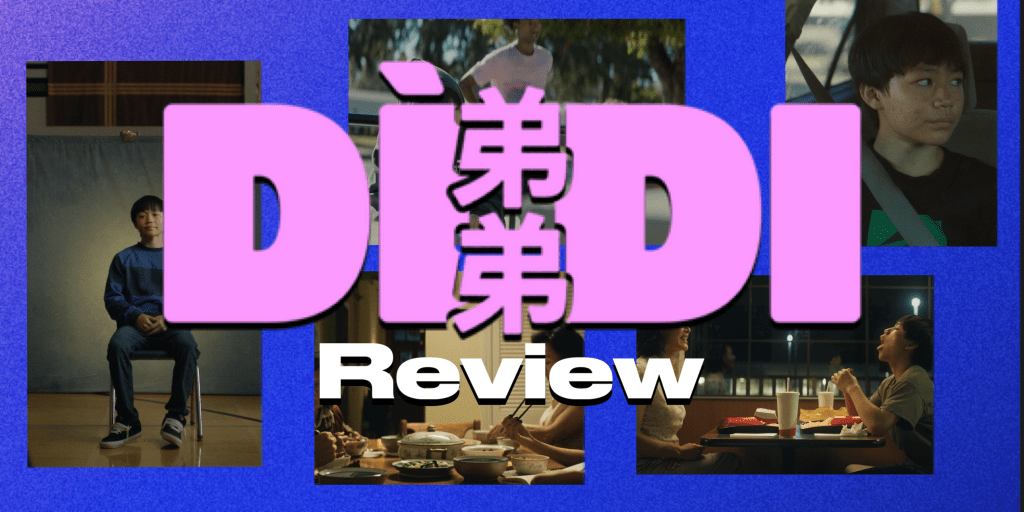
Sean Wang’s Dìdi is a truthful trip back to 2008 in the messiness and self-sabotage nature of finding one’s self during the early teen years.
A very pivotal moment in an American’s life is the transition from middle school to high school. Entering the chartered unknown where you feed into a larger ecosystem featuring faces you haven’t encountered before. It can be a time to reinvent oneself which usually sends the not-quite-yet-developed frontal lobe human down a path of destruction and self-sabotage.
In 2008, 13-year-old brace-faced Chris Wang is set to start high school once summer ends. Chris’s summer days consist of hanging outside with his two close friends trading homophobic and sexist jokes when he’s not locked inside his bedroom surfing the clunky pc situated at his desk. As a skateboarding protagonist, Chris is pretty flawed which adds a sense of authenticity to Sean Wang’s coming-of-age tale. Chris is not working to become a better person but to make sure he is set for high school with what would deem him cool leading him to be awful to his mother and sister and spread a sexual rumor about his crush. He’s not a terrible human, those actions mask an insecurity in his sweet soul that at this age we don’t often know how to communicate with those around us or are too embarrassed to admit.
Wang explores this often hidden side of the coming-of-age genre so rawly in his ability to let the camera linger on Chris’s constant wrong choices and how they all add up to causing hurt to not only himself but those around him. There is a point humans reach where innocence is broken and we realize that the reality of the world is we won’t always be forgiven for our actions and have to figure out a way to live with it. The vignettes of summer spliced together to craft a tapestry of who we are and how those around us perceive us and that is what Chris is forced to learn in one summer.
At home, Chris is surrounded by the women in his life including his mother played by the incomparable Joan Chen. Movies revolving around Asian cultures often portray the Asian mother as stereotyped as strict and only caring about grades, but Joan Chen brings new dimensions to how we see Asian women onscreen. A single mother due to her husband being away at work, she is working to be the glue holding her family together amongst the pressures of their culture and a naggin mother-in-law who never misses an opportunity to tell her what a disappointment she is. Throughout the film, she maintains a strong face for her children but when she finally breaks down into a vulnerable state it’s when Chen genuinely shines in a powerhouse performance that would break anyone. She is straddling a generation of her mother-in-law and children trying to find where she, a failed artist, actually fits in. Chen is extremely gentle and tender with her deliveries that you hook into every movement and word oto feel her pain.
Throw in the social pressure of low-fi technology that even more complicated the journey of finding a sense of self. In a much simpler time compared to today’s overstimulation of screentime, Dìdi becomes a time capsule of the intricacies of 2008 juggling the end of MySpace and the resurgence of the Facebook era amongst the below-18 crowd. Chris patiently sits at his computer typing to his crush with an editing job that makes these little moments feel like life or death in the mind of a thirteen-year-old. Technology is interwoven so naturally into the story of how aids in forms of self-expression and communication for this specific generation.
Growing up in this period you can remember making fake Facebook accounts to see what your classmates were doing outside of school creating an early onset of fomo. Wang nails how the start of the social media age built an additional connection to our peers in their outside life seeing who they were hanging out with and where making it a bit easier to fully adopt another identity just to know what to say to morph into the it crowd.
At its heart Dìdi is a tale of identity and how when you feel like an outsider you are never able to find your sense of self. Wang’s script hides subtext on how Chris’s culture is a major source of his insecurity around his peers. One microaggression from his crush on how he is “pretty cute, for an Asian” prompts an immediate sadness evoked by Chris’s withdrawal. His identity is defined by those around him as Asian instead of giving him the space to show the world who he is which is seen manifested in the skate videos he makes and multiple poor attempts to be seen as something more. As this is a personal story from Wang it is also a cathartic exercise for the writer/director to reflect on this age of adolescence and how these comments on his culture added to his inability to word how he was feeling.
Dìdi, though specific to Sean Wang’s childhood in Fremont, works as a compassionate universal tale on the anxieties of finding ourselves and the fact that sometimes you just need the nurturing of your mom.
Grade: A
Oscars Prospects:
Likely: Best Original Screenplay, Best Supporting Actress (Joan Chen)
Should be Considered: Best Editing
Release Date: July 26, 2024
Where to Watch: In Select Theaters

Jillian Chilingerian
she/her @JillianChili
Lives in LA. Loves Iced Americanos and slow burns.
Favorite Director: David Fincher
Sign: Leo


 offscreencentral.com
Leave a comment