
“I love that you get cold when it’s 71 degrees out. I love that it takes you an hour and a half to order a sandwich. I love that you get a little crinkle above your nose when you’re looking at me like I’m nuts. I love that after I spend the day with you, I can still smell your perfume on my clothes. And I love that you are the last person I want to talk to before I go to sleep at night. And it’s not because I’m lonely, and it’s not because it’s New Year’s Eve. I came here tonight because when you realize you want to spend the rest of your life with somebody, you want the rest of your life to start as soon as possible.”
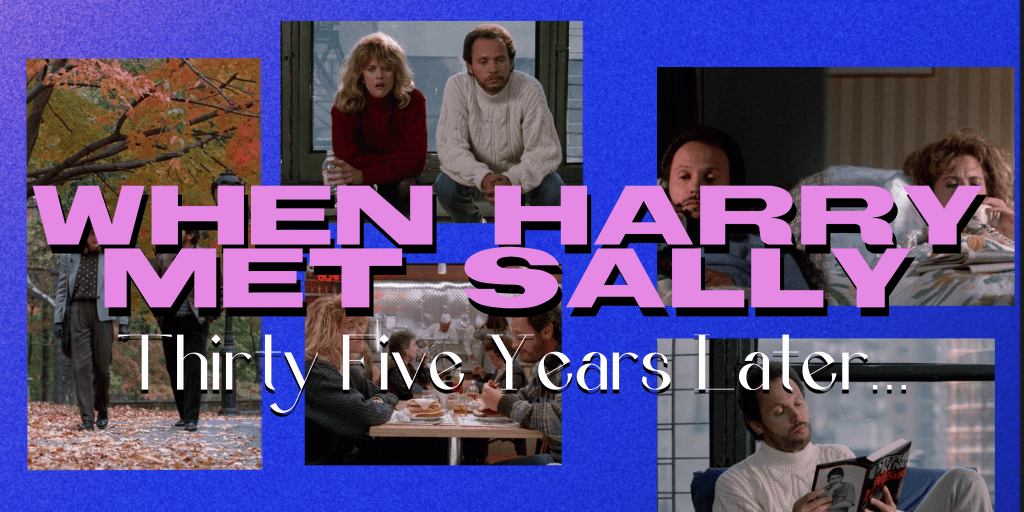
Can men and women ever be friends? And what does it mean to fall in love? 35 years ago, director Rob Reiner and screenwriter Nora Ephron brought to life the romantic comedy for the ages: When Harry Met Sally…
Harry Burns (Billy Crystal) first meets Sally Albright (Meg Ryan) in Chicago. Recently graduated from college, the pair are moving the New York City, not together. Their road-trip actually highlights their differences. Harry is a bit crude, self-centered, and leaning into the stereotypes of a young 20-something man. Sally is uptight, stringent, and cannot quickly order food to save their life. But most importantly, to Harry’s point, men and women cannot be friends.
The time taken at the beginning of the film helps to establish our protagonists. You get a glimpse of their motivations, their philosophies, and their ambitions. It also brilliant aids in giving the audience a starting point, a place to reflect at the end of the film’s 95 minute runtime. Something romantic comedies nowadays suffer from is that lack of foundation. It is difficult to create conflict when the dynamics of your romantic leads is paper thin. On the other hand, having what attracts two people spelled out to its audience is boring as well. In her screenplay, Ephron knows how to bake in foundational information without patronizing her audience. Instead, leans into conversation to divulge the inner workings of her characters.
Throughout the film, as the pair encounter each other several times, we get glimpses of where life has taken them. By the time Sally and Harry decide to be friends, Sally is no longer with her longer-term boyfriend and Harry is getting divorced. They are navigating dating as 30-something adults – though Sally will mention she is close to 40 at the age of 32. In contrast to their self-assured attitudes and steadfastness of their early 20s, Sally and Harry are now rediscovering who they are and having to re-evaluate what they want their futures to hold.
Character development aside, having two romantic leads who plausibly and truly like each other is key. Crystal and Ryan ooze charisma and charm. Their banter is fun. They are more alike than they realize. They are both hot. They can really pull off a sweater. Their journey from strangers to friends to partners makes sense. While Sally can be a touch neurotic and rigid, Ryan also shows her wit, her humor, and her deep insecurities. Harry gets some of the most character growth in the film. Crystal takes him from smarmy recent grad to a man who’s had his heart broken and has clearly gone to therapy. (Reader, please let me live in this fantasy. Okay? Harry Burns has gone to therapy). When they’re together, they see each other as people, as equals. Not someone to complete them, but as a separate person who makes their life richer. Without Crystal and Ryan, you really don’t have Harry or Sally. They so intricately understand who these people are as individuals and as a pair.
The film isn’t only about Harry and Sally. Their best friends, Jess (Bruno Kirby) and Marie (Carrie Fisher), are perfect confidents. Jess and Marie meet because of Harry and Sally. Sally hopes Marie can leave her boyfriend who won’t leave his wife for her friend Harry. And Harry hopes Jess and Sally find happiness together. Instead, Marie and Jess quickly fall for one another. Their love story feels so effortless – even when they are arguing over a wagon wheel coffee table. In comparison to Sally and Harry who have to take detours before their happy ending, Jess and Marie just know this relationship is it.
When Harry Met Sally… brilliantly allows for all types of couples to be represented on screen. Albeit, we really only see heteronormative couples – it is 1989 after all. The film is peppered with couples being interviewed about their own love stories. These segments were stories Reiner collected from real-life couples and the stories were relayed in the film by hired actors. These love stories bring an authenticity. It is not always “boy meets girl, they fall in love, happily ever after.” Sometimes it’s love at first sight, and other times it is love after four failed marriages. We see couples who are completely on the same wavelength and couples who are polar opposites of each other. Where many romantic comedies feel generic, When Harry Met Sally… knows that the most important stories straddle universal and personal; it gives us an global understanding of love while giving us intimate glimpses of specific hues of romance.
While the script provides the foundation, it is the direction that adds magnetism. Reiner perfectly captures friendships turned romantic relationships. Harry and Sally are given equal opportunities. We see their missteps, their growth, their convictions, and what makes them special. Reiner never sacrifices the groundwork laid by Ephron in her script for his own vision. He understands how to collaborate in his creativity. Without Reiner’s perspective, without Ephron’s perspective, this film would not work. Reiner also understands how to capture comedic beats perfectly. A prime example is a scene, after Harry and Sally have had sex together for the first time, they call their best friends Jess and Marie, respectively. Complicating the matter, Harry and Sally call their friends individually, but Jess and Marie are literally next to each other at home. As Jess and Marie navigate a delicate dance, Harry and Sally are none the wiser. It is utterly fantastic, but what makes it work best is how it was filmed. Usually, you would film the three sets separately, on different days, at different times. But Reiner knew that to nail the tone of the scene, to get the comedy right, all four actors had to be filmed simultaneously at the three separate sets on the same soundstage. It took 61 takes. But that level of detail is what makes the film so singularly special.
For 35 years, When Harry Met Sally… has been a staple, continually discovered by new audiences. Personally, every year on New Year’s Eve, I have to watch the film. It’s been an almost 15 year tradition. It is a film that has become the shining example of what a romantic comedy can – and should – be. It is frequently found on lists about love, all-time favorite films, Letterboxd top fours. It has become profoundly foundational cinema for many film lovers.




 offscreencentral.com
Leave a comment