
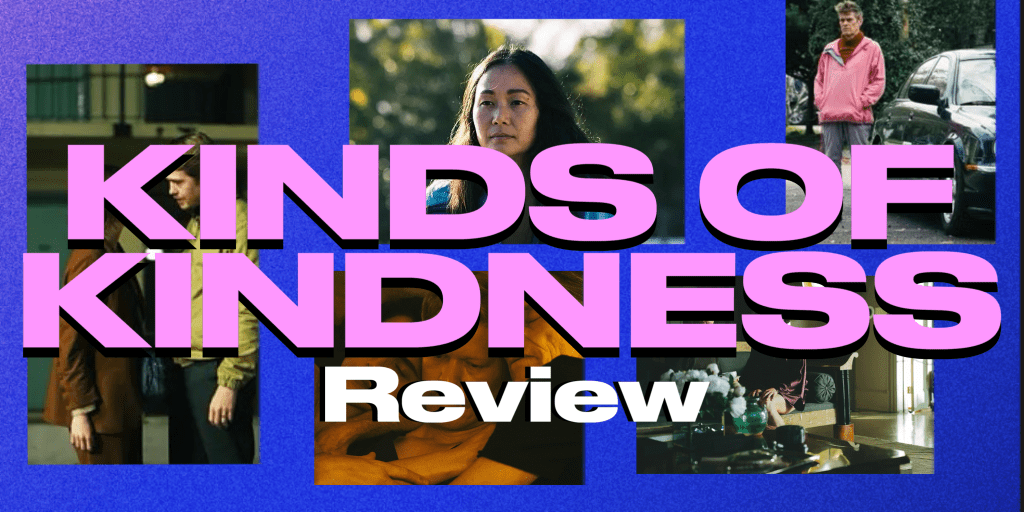
Part Dekalog, part hipster sketch show, part children’s tall tale, Kinds of Kindness is a deeply comedic return to freak form for Yorgos Lanthimos as he explores the desperation spectrum of co-dependent humanity.
Split into three separate stories populated by the same actors as different entities set in a contemporary unrecognizable US city. This plays into Yorgos’s specialty of a constrained environment where characters can run free as they like the audience are piecing together the story simultaneously. His very experimental nature in sociology is on full display highlighting what he does best, pushing humans to their breaking points in a world crafted by his own rules.
The first of three sketches follows Robert, played by Jesse Plemons, a man who is under the thumb of a controlling boss who decides every move for him from his daily dress to how many children he should have. Robert is stuck in a loop in this power imbalance succumbing to every outlandish request based on what Raymond knows best until he is asked to crash into another car at high speed to land himself in the hospital. Continuing on the theme of Jesse Plemons being gaslighted to think he is going insane; the second story follows Plemons once again but this time as a policeman whose wife has been missing from a diving expedition. She is found, but Plemons is convinced that this woman is not his wife. Taking the themes of a literal godlike force ruling over humans, the third story follows a water-obsessed cult decked out in pantsuit and sandals ensembles with Plemons and Emma Stone on the hunt for a woman who has the power to reanimate the dead.
Each story shares similar themes but feels like a completely different film on its own making one review dissecting the intricacies of each feel like an impossible feat. There is no crossover of characters or locations, once the story is complete and the audience thinks they put together the story it immediately dives headfirst into the next chaotic scenario. Lanthimos throws the audience into a cesspool of delirium and it’s up to them to figure out how to swim through or sink into their senses. It helps that Lanthimos, and his collaborators use music and camera framing to clue in the viewer to always feel on alert to what twists can unravel as they lean in to soak up each sentence. Sometimes it feels like lines are thrown out to knock off the clear story one is concocting in their head as they intake the scenes, but it adds to the lore of depicting fact versus fiction. Each story has its own rules devised by Lanthimos’s scripts that we are tasked with understanding using the actions of the characters as a framework.
Expanding on his favorite motif of control, Lanthimos establishes each dimension exploring control manifesting in corporations, marriage, and religions for the three parallel universes at hand. They all are set within very contained locations and behaviors where characters know what they are expected to do by those of higher power. All willingly give up their power to follow rules by the domineering leader before them, in turn, to make themselves empowered for being followers. Even though humans desire control, there is nothing like the feeling of winning someone you admire approval that at the end of the day will trump all other feelings. This can lead one down a very harmful path as is common in Yorgos’s tales. A pure descent into desperation disguised as love mainly to prove loyalty and regain the approval they seek. When one doesn’t have the confidence in themselves to live causing an internal gaslighting of their sense of identity and self-free of control. These characters aren’t inherently good or bad nor are you being told to judge them. In the moral grey of morality, they must scalp whatever means possible to win back good graces and receive their status in society. Because this world is fictional, the cruelty acts don’t hold the same value as they would if you saw your neighbor committing them. Since it all films a centimeter off, there is no room to determine if these are rational actions; it is just watching someone do what they think is right in the moment for the reward they are expecting. What will one do to themselves for the sake of this approval? Hit someone with their car, leave their husband and child, or remove their liver for their significant other to eat? Lanthimos certainly plays to extremes in his articulation of the lengths one goes for another, but even the most offbeat courses are the norm in his playland.
Robert knows Raymond’s tactics; every day begins with a notecard instructing what he should eat and what book he should be reading. Every aspect of his life has been curated by this dominating man, there is no mention of his life before Raymond, only an existence brought to him by Raymond. When he steps out of line, he is instantly kicked out of this pattern leading him to a life on his own for the first time. Free of the shackles, Robert has no clue how to survive without Raymond. Suddenly he is shunned from everything, his house is left a mess, his wife leaves him, and he has nowhere to turn but to himself resulting in a pure destruction of everything Raymond built. He once felt like the most special person in the world, but his ignorance to take it for granted has come back to bite him in the form of a new protege, Rita, to Raymond who follows instructions very carefully. Robert is the first of the Kinds of Kindness troupe to result in pure desperation to win back the admiration of his superior.
Lacking the fantastical, periodical aesthetic of his previous two films Kinds of Kindness is contemporary but it doesn’t limit it to being able to transcend into any period. The timeless tale of humans disappointing superiors and then winning back favor goes back centuries, most certainly in the tale of Adam and Eve in the Garden of Eden. Kinds of Kindness is an auteur’s Garden of Eden full of cruelty and kindness for one to navigate to stay in good graces until stepping outside the drawn lines leading to an expulsion to self-mania. The real pain in life is not violence but the thought of being excluded, sharper than any knife to the heart. It can break a person to the point of insanity.
That being said, the true craftsmanship in the story outside these actors and their commitment to what feels like an improv exercise given to them by Yorgos is the insane score by Jerskin Fendrix and editor Yorgos Mavropsaridis. Echoing the internal monologue of a human making terrible decisions that will cause harm to them and those around them, the booming “nos” in the score sprinkled throughout raises the stakes of the day-to-day. Guards are never let down as long as the score runs evoking claustrophobia on these characters that live exclusively on screen and can’t even escape themselves. Unlike the previous two films that display sex as a pleasuring, shameful act, the way bodies are shot in intimate scenes is pretty hilarious.
This nonsensical outlook on society never misses a beat or punch which is very rare for a film to keep its audience’s interest for almost three hours. The jumping storylines certainly work toward a generation used to swiping between content and Yorgos knows exactly where to start and stop luring everyone into pure bafflement and quickly taking them out into the next. A game of edging in the world of arthouse cinema is at play thrusting the boundaries of what an audience will tolerate from the man behind Dogtooth. Putting in a thumping pace allows creative freedom for the story to turn to whichever way and maintains this idea that you aren’t supposed to figure out what is occurring around you. Like the characters you are lost adrift in this alien world that mirrors our own but is slightly off. The editing between stories doesn’t allow you to sit too long with what you experienced, immediately jumping into the next adventure like a sketch of SNL or Portlandia forcing you to leave behind and piece together a completely different set of regulations in a new sphere of life. The same rules apply in different fonts at different speeds in different contexts, but all amount to control.
Kinds of Kindness isn’t something you get. You watch it and let it overtake you. It is the type of film that receives the status of sparking dialogue and discourse depending on how the viewer interprets what is being communicated. There are a lot of coincidences in terms of themes of pregnancy, eggs, twins, chocolate, and dreams being topics of discussion in each story. This can speak to Yorgos’s use of dialogue in his projects, always robotic and never natural. The key to a good performance in his films is to place the responsibility of being grounded into the characters juxtaposing the silly situations surrounding them to give an ounce of realism. These styles work together in harmony allowing the viewer to put actual stakes and belief into caring about these horrible people and their outcomes. It is the secret to making unlikable people likable. Taking simple words that would often pop up in a human conversation, but the delivery makes them feel uneasy, maybe hinting at a greater meaning in their strange occurrences. Characters have dreams from Robert picturing his confrontation with Raymond to Emily seeing a vision of the chosen one. Humans often have permutations that play out in real life, in these cases since these specific humans are searching for something greater it speaks to the idea of a higher being always being present playing with humans like a game of chess. No control over their actions but someone always gives them the steps they need to take to reach success, does free will exist if someone is dropping cheat codes on you?
For the most part, these characters are rewarded for coming to what they think is their own decision in that they need this guiding principle to live. Once they dismiss their egos, open arms welcome them back and the balance of life is restored. There is the chance that being too cocky can keep you exiled like for Miss Emily when she figures out the key back to her water-guzzling cult after being contaminated leading to a rather unfortunate incident involving her purple Dodge and a stationary boat for sale. Turns into a very ironic situation when she kills off a healer on her way to a boating haven, you can’t have it all. Jesse Plemons is put through the ringer being this symbol of pathetic despair and his years of supporting roles have pushed him into a prime leading man teetering between sinisterism and emptiness. In comparison to his expressionless co-stars, his moments in the stories carry a significant amount of weight in dictating the subtle shifts of tone. His shells of human beings never stop to reach his goals whether outing his fellow cult member or running over a bruised body until Willem Dafoe lets him back into his fortress.
Kinds of Kindness sets up its thesis at the end of Act One with an offkey keyboard performance of How Deep Is Your Love by Margaret Qualley. Love runs deep and what better way to prove it than to cook your thumb for your significant other? At the end of the day, humans are flawed, and the real fear is disappointment in those we admire. One choice can derail all built-up good causing one to lose it all and Yorgos depicts this in the most extreme disturbing terms never holding back and never explicitly telling the audience what he is doing. Humans are cruel, Humans are kind, and Humans will do whatever it takes to earn the love they feel they deserve.
Grade: A+
Oscars Prospects:
Likely: None
Should be Considered: Best Editing, Best Actor (Jesse Plemons), Best Original Screenplay, Best Score, Best Production Design
Release Date: June 21, 2024
Where to Watch: In Theaters

Jillian Chilingerian
she/her @JillianChili
Lives in LA. Loves Iced Americanos and slow burns.
Favorite Director: David Fincher
Sign: Leo
 offscreencentral.com
Leave a comment