
1999 was a banner year for film. And you know this is true because it (coupled with 1985, 2007, and 2019) are the nostalgia fodder of Film Twitter. It was a year that furthered or birthed franchises (The Matrix, Star Wars: Episode I – The Phantom Menace, Toy Story 2), but it is more widely remembered for being a year that ushered in a new guard of voices in the filmmaking space.
And one timelessly comedic offering from this new class of filmmakers leading Hollywood into the new millennium is Election, directed by Alexander Payne.
I didn’t come across Election until 20 years after its release during my junior year of college. In my History of Cinema III class, I was prompted to write an essay on two films from 1999 and discuss their impact on the year. With many films on the list being ones I didn’t have much interest in, I haphazardly chose to watch Election and Any Given Sunday to compare. I might’ve gotten a B- on that paper, but I walked away having found one of my new favorite films.
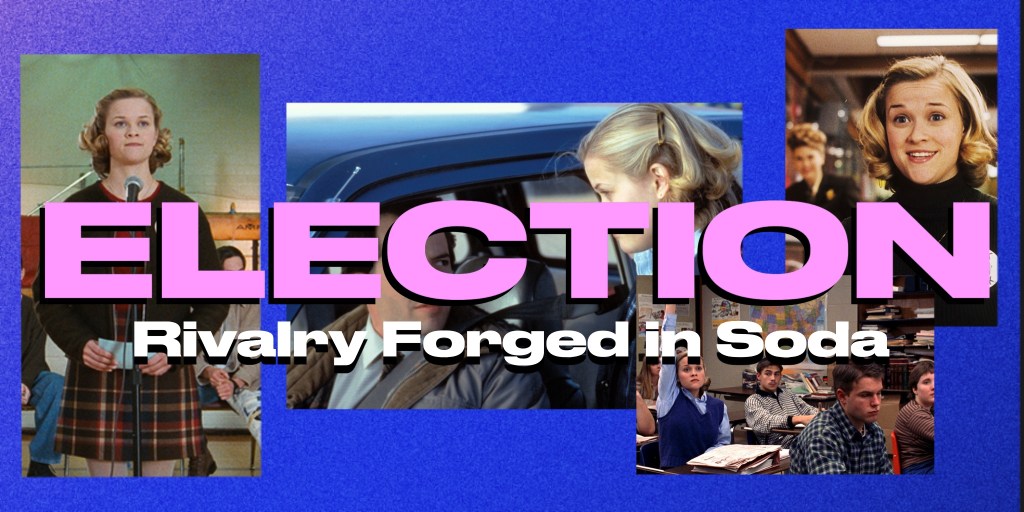
On a macro scale, Election, an adaptation of the 1998 Tom Perrotta novel of the same name, follows the twists and turns of the age-old American high school tradition of a student body election. The proposed candidates of George Washington Carver High School’s student election are overachiever Tracy Flick (Reese Witherspoon) and lovable idiot hottie jock, Paul Metzler (Chris Klein) with Paul’s sister, Tammy (Jessica Campbell) as the brief dark horse candidate.
On a micro scale, it’s a story of ambition, competition, deception, political intrigue, soda, and one (1) loser man.
While the titular election is the main event, the core of this film is the dynamic between Tracy and her teacher and advisor of the student government association, Jim McAllister (Matthew Broderick). A scene at the beginning of the film features an expositional flashback featuring dueling narration from Tracy and Jim as they seemingly answer the question of “Who are you?” In it, both characters present their best versions of themselves that we begin to see unravel as the film goes on.
Tracy Flick is a winner. She is the girl who had time for every extracurricular and every advanced class. She tracks the class ranking like a finance bro tracking the NASDAQ (Note: I don’t know if you can track the NASDAQ. I don’t understand their culture). She knows everyone, not because she cares, but because she knows that she needs to know everyone so that everyone can vote for her. She is a Politician, and the election of student body president holds the same emotional weight as a 4-year term as president of the United States. This means everything to her. (Rachel Berry, this is your mother.)
Reese Witherspoon sends in a knockout performance as Tracy. In both her emotions and physicality, she offers an undeniably brilliant showcase of a girl who has never been afraid to be seen trying. Also, we got Tracy Flick and Annette Hargrove from Cruel Intentions from her in the same year. Women’s stories matter.
Her biggest downfalls aren’t really her ambition, but it is her naivety (and that she’s a little annoying). And that naivety was mainly due to the fact that she was a high schooler. Flick, in her unstoppable ambition, fell victim to the “mature for your age” trap. I think she had been told from a very young age that she was ahead of the curve, that she was unique, that she was different. And in turn, she took that as not really needing to feel like she was a kid and she’s incredibly lonely because of it.
The only time that she got any real social attention was when she was being taken advantage of by one of her teachers, Mr. Novotny, a close friend of Jim. Because she didn’t feel understood by her peers, she found comfort in being understood by an authority figure and Novotny took advantage of that.
And speaking of, let’s talk about perennial loser, Jim McAllister. Jim McAllister. The happy-go-lucky teacher who just cares so much about his students and wants to do right by them. Unless you try too much then who the fuck do you think you are? Which is fittingly Jim’s last line of the film.
Matthew Broderick delivers a believably pathetic performance that straddles between sad, understandable, and infuriating. I roll my eyes at his sheer presence (complimentary).
By all accounts, Jim is a decent guy, but his sinister streak rears its ugly head with Tracy. He views her as not just annoying, but dangerous. If she wins this (not at all important) student body election, what will become of the school? What will his day-to-day life be like under the tyranny of Tracy Flick? He has to be the force to cut her down. The force to stop her. He will be the one to save the world from the nuisance of the girl whose worst crime is not brushing out her curls.
While my disdain for Jim McAllister is #notsubtle, the film doesn’t seek to solely vilify or lionize Flick or McAllister. There’s not really a Winner or Loser when it comes to this film. As critic Dana Stevens describes in an essay for the film’s Criterion Collection release, “Payne’s characters may see themselves as figures in a spaghetti-western-style landscape of moral absolutes, but their real value lies in their refusal to inhabit the Hollywood hero-to-villain spectrum; they’re banally human and humanly banal, lovable for the very qualities that make them terrible.”
And it’s very interesting to see in the legacy of this film that people were very certain that Tracy is the villain not worthy of any moral gray area and Jim as the hero pushed too far. I’ve got an idea as to why that is. Rhymes with blisogyny.
Jim and Tracy’s feud is best described as not a tale of polar opposites but polar same’s. They’re not Coca Cola and water, but rather, Coca Cola and Pepsi, the same but one is always a little bit better than the other. And funnily enough, these dueling soda brands are a motif that we see carried throughout the film.
Though she is running unopposed, Tracy took campaigning very seriously and when questioned by Jim about it, she likens her campaign to Coca Cola – “Coca-Cola is by far the world’s number one soft drink, and they spend more money than anybody on advertising. I guess that’s how come they stay number one.”
A few scenes later, we see Jim in his basement, sitting down to peruse his extensive porn collection before landing on a football and cheerleader themed tape with a crisp Pepsi in tow. While watching a scene in the film with the football player, he hatches a plan to get one of his students, Paul Metzler to run against Tracy. Yeah, I know, gross.
Later, in the film, we see that The McAllister’s have Coca-Cola in their upstairs fridge. This shows the binary of a character like Jim. He presents as the top dog, go getter (like Tracy), but in his basement holds his actual personality, that of second best. The soda motif is subtle but extremely effective in explaining the feud between Tracy and Jim.
They’re the same in that they do want the same things (to teach and to lead). They have the same drive. However, you can see that Jim is always viewing Tracy as competition. He’s always preoccupied with what Tracy is doing and bringing her down, whereas Tracy does not think about Jim nearly as much as Jim thinks about her. A very Coca Cola and Pepsi dynamic.
Beyond Tracy and Jim are a fun cast of supporting characters, including the Metzler siblings, Paul, and Tammy.
Paul Metzler is your typical jock stereotype with an unwavering earnestness to him. A ski trip injury leaves him out on the bench for the upcoming football season, which frees him up as the perfect cog in Jim’s political machine. Jim did not care whether Paul really wanted to be student body president. He just wanted to take Tracy down a peg, and he knew that if he couldn’t beat Tracy’s ambition, he could beat Tracy’s popularity, and Paul was popular. However, in the end, Paul could be best described as “happy to be there.” He was stoked when he became president, and he was equally as stoked when the decision was overturned, and he wasn’t president anymore. Chris Klein gives a delightful performance as Paul that makes you oscillate between “aww” and “Bless his heart.” The lights are on but no one’s home with Paul, but as a chronic himbo lover, I’m into it.
His little sister Tammy could not be bothered with popularity and couldn’t care less about a student body election (as made evident by her rousing, anarchical second act speech). She definitely has Fiona Apple quotes written on her notebook and she most definitely hitchhiked to Lilith Fair. Her life is preoccupied with a girl. A girl named Lisa with whom she is in love with, but who leaves Tammy when things get too serious (and promptly begins dating her brother in retaliation). Her one and only motivation for participating in this election is to then get back at Lisa through running against Paul.
The late Jessica Campbell gives an unforgettable performance as Tammy that humorously captures late 90s teen adolescence in a way that is truly timeless. Never forget her prayer after getting sent to all-girls Catholic school wherein she requests a pair of expensive leather pants and to be best friends with Madonna. A woman of priorities.
If Tracy is the candidate that wants it some much and Paul is the candidate who runs because people think that he should. Tammy is the best example of how this story, which was based on the 1992 U.S. presidential election, is really indicative of the average American in any given election. In her speech, she says that becoming a president really only has ever benefited the person who becomes the president. These elections are full of toothless campaigns with promises that never come to fruition.
Election turning 25 in an election year makes it essential viewing.
In tandem with great performances, Alexander Payne and Jim Taylor’s Academy Award nominated screenplay makes this squadron of characters feel whole and fully realized while laying out a darkly comedic political satire set in a mundane location.
Election holds a special place in the teen comedy boom of the late 90s. These films felt very relatable, personal, and marked the turn of the teen comedy moving from aspirational to relatable. Rather than being set in some swanky aspirational place to grow up as a teen like any coastal west coast town or Gilmore Girls-ian New England, films like Election and another equally underrated 1999 teen comedy, Drop Dead Gorgeous, were preoccupied with depicting a hyper specific slice of life for a teen somewhere in Our Town, USA. These films offer comedic takes on these specific regional dialects and cultures through the eyes of the teens that live there that weren’t all parties and dubious dress code policies which led the way for the renaissance of teen comedies that we’d get in the 2000s, 2010s, and now.
At 25, Election feels both perfectly of its time and timeless. It’s a brilliant snapshot of late 90s middle America through Jane Ann Stewart’s production design and Wendy Chuck’s costume design. And timeless for its eternally relevant satire of the American political theater that feels as useless as a high school student body election. However, if given the opportunity, I’m always going to Pick Flick.




 offscreencentral.com
Leave a comment