
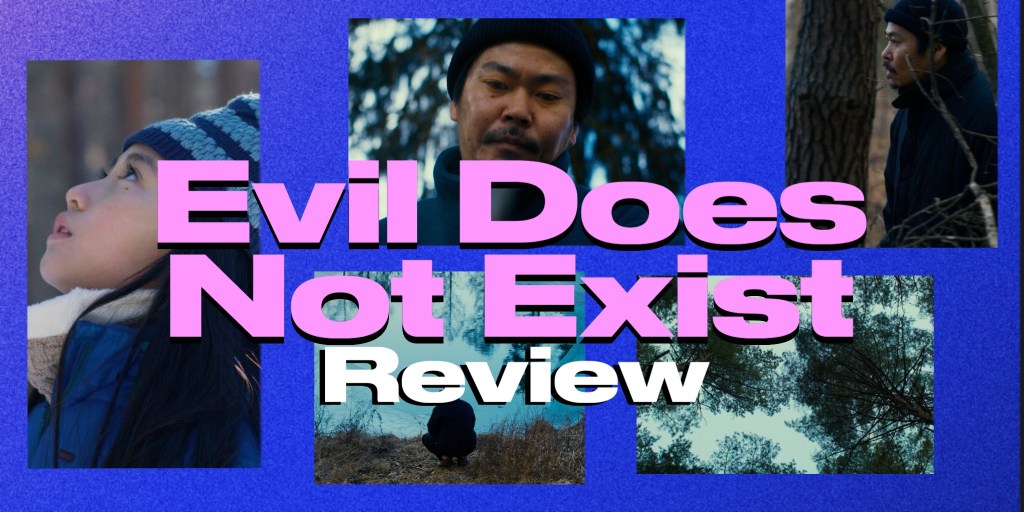
Evil Does Not Exist is a perfect example of Ryûsuke Hamaguchi’s strengths as a storyteller. The film asks many questions and provides no answers making for a thrilling experience that washes over you. The ethereal, dark tale explores the balance between human nature and the natural world.
Ryûsuke Hamaguchi is one of the most visual and complex storytellers working today and Evil Does Not Exist continues to prove his incredible hand at both directing and writing. The film opens with a seemingly endless single take of the forest canopy above in almost hypnotic view as we are transported to the town. The music (by Eiko Ishibashi) engulfs the audience as you become entrenched in the mindset Hamaguchi is leading you towards. Is this forest sinister? Is this forest safe? Evil Does Not Exist does not answer any of this, it’s all about how you perceive as you watch the film and more unfolds.
In the small town of Mizubiki, just outside of Tokyo, Takumi (Hitoshi Omika) lives a mostly isolated life with his daughter Hana (Ryo Nishikawa). As the film carries on, we see that Tamuki is seen as the local handyman, and he makes a living by completing jobs around the town. Takumi’s life is ordinary and almost mundane, but Hamaguchi shows the beauty of this. Every step throughout Tamuki’s day is with purpose but he connects himself to the nature around him. It feels romantic but not as if Hamaguchi is romanticizing the idea of a mundane life in a small town; Hamaguchi is such an authentic storyteller it always is grounded in a reality.
This ethereal feeling comes to almost a halt when it is revealed that plans are underway to establish glamping sites for tourists in the village. Representatives from the company, Takahasi (Ryuji Kosaka) and Mayuzumi (Ayaka Shibutani), arrive in the town to hold an open discussion with the residents. The representatives from the company’s behalf clearly were not expecting such a researched, passionate response from the town. It becomes clear the environmental and societal impacts had not been considered as the company is not aware of the respect and admiration the town has for its environment sustaining the town. Takahasi and Mayuzumi slowly begin to realize the company’s approach was not the correct way to enter a town and they want to work alongside the town. The duo notices in the meeting the townspeople almost rally behind Takumi like a spokesperson not only for the townspeople’s feelings, but the physical town itself. No one knows it better than him. They quickly ask to work alongside him to ensure the best outcome for the company they represent as well as the people of Mizubiki.
As with his previous films, Hamaguchi uses long unbroken takes not even just of the beautiful nature of the town, but of each character. At times, it feels there’s an unseen person’s POV guiding the audience in what could be either a sinister feeling or a loving feeling. Evil Does Not Exist uses opposite forces to explore the themes Hamaguchi is unfolding for the audience to figure out; from the nature and technology to young and old, all of these forces are acting against each other.
Evil Does Not Exist offers no answers as it presents questions of what life is meant to be or how these forces should act together in harmony versus battling it out. When Takahashi decides he wants to live a life more like Takumi, Mayuzumi questions him and his motives, but it remains up for the audience to decide the true meaning behind the switch. As the film goes on, there are bursts of violence that manage to startle its audience, but Hamaguchi never loses control over the tone or story being explored. The balance of nature and humans has been off for years, but Hamaguchi is presenting that there is no harmony between the two. The glamping company and clients assume you can buy that harmony for a weekend away in nature. Evil Does Not Exist shows once these paid for comforts are gone all that is left in nature will be the real predators.
Evil Does Not Exist is a perfect example of Hamaguchi’s strengths as a storyteller. The film asks many questions and provides no answers making for a thrilling experience that washes over you. The ethereal, dark tale explores the balance between human nature and the natural world.
Grade: A
Oscars Prospects:
Likely: None
Should be Considered: Best Lead Actor (Hitoshi Omika), Best Original Score, Best Cinematography
Release Date: May 3, 2024
Where to Watch: In Select Theaters

Kenzie Vanunu
she/her @kenzvanunu
Lives in LA. Misses Arclight, loves iced vanilla coffees.
Favorite Director: David Cronenberg
Sign: Capricorn




 offscreencentral.com
Leave a comment