
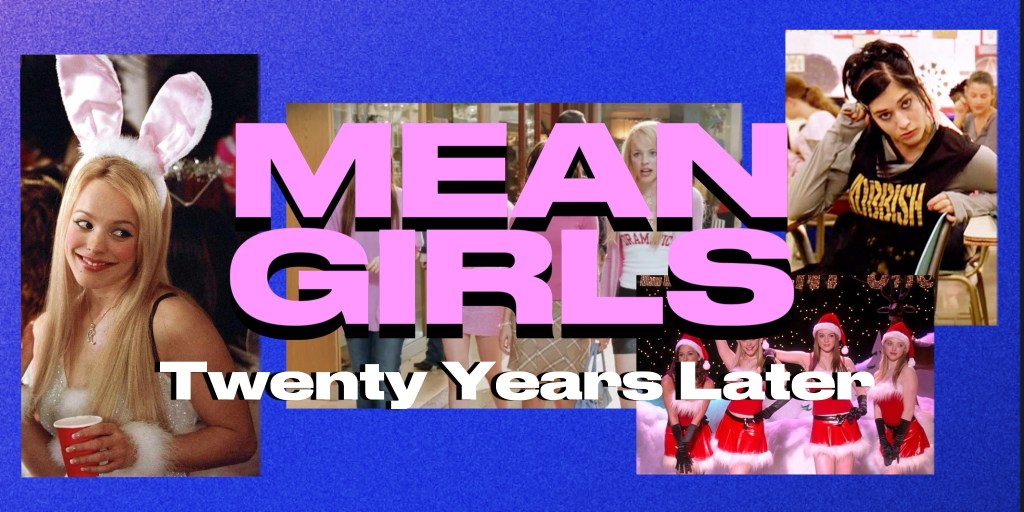
“Stop trying to make fetch happen,” I overheard one of my classmates recite the line to another in the hallway of my middle school. When I ask what they’re talking about, I’m told it’s from a movie called Mean Girls. I have never been more annoyed by my summer birthday until that moment. While all my friends were 13 and could experience the cultural event of a lifetime, I was 12 and experiencing my first bout of FOMO.
Regardless of when you watched it, Mean Girls created a paradigm shift in pop culture. Over the past 20 years, the film has been parodied, referenced, examined, turned into a musical, and that musical turned into a movie. Its enduring legacy has cemented it as a cinematic classic. While being a product of its time, it also has undeniable universality.
At its foundation is a smart and witty script from Saturday Night Live alum Tina Fey. Fey took the Rosalind Wiseman book, “Queen Bees and Wannabes,” and shifted the text from a parents’ guide to understanding teenage girls to conversation with teen girls about their adolescent experiences. The film was released at a time when teen girls were facing endless projection: who they are, who they should be, how they should look. Coming off of the diet culture of the 90s and entering into the beginning stages of social media, Mean Girls hit at the right moment to speak to teenagers.
The film’s main character, Cady (Lindsay Lohan) serves as a blank slate, allowing for some of the more unrealistic expectations of adolescence to be filtered through her consumption of the world around her. Lohan, who faced public scrutiny in the following years for having all of her early adulthood missteps documented on the front pages of tabloids, perfectly captured Cady’s naivety as well as her inclination to be drawn to the clique of mean girls. She shows how easy it is to lose oneself, and does so without judgment. I think there are many ways in which the film could have vilified Cady or belittled for her misguided choices. It never condones her behavior but allows it to be messy and complicated and honest.
Cady’s first friends Janis Ian (Lizzy Caplan) and Damian (Daniel Franzese) are the perfect representation of the kids existing just on the fringes of the high school ecosystem, but are aware enough of their surroundings to maneuver through the minefield of adolescence. Janis certainly marches to the best of her own drum, but even in her individuality, she holds some insecurities about being different. As we know, in the 8th grade, a rumor was started that Janis was a lesbian, which really made Janis an outcast. The humiliation and isolation she endured has also made her a little vindictive. Even so, Caplan ensures that Janis is understood in both her pain and resilience. We get to see someone rebel against the status quo while also questioning those in positions of power, especially when those people are her peers.
Damian was a revolutionary character to see 20 years ago. Gay and out. While his sexuality does make him a bit of an outcast at school, he is able to live authentically enough, largely unbothered by his peers. When he brilliantly sings “Beautiful” at the talent show and a shoe thrown at him, he immediately regains control of the situation, keeps going with his performance. In a 2019 interview, Franzese has remarked how cathartic it was to portray Damian. When gay characters were relegated to weak and meek characterizations, Damian was the opposite. He was able to exist in high school as his authentic self and outside of a student or two, no one batted an eye at the fact he was gay. Even with a few moments of stereotyping, Damian gets to exist authentically.
The same goes for our core trio: The Plastics. There are some single notes to Karen (Amanda Seyfried) and Gretchen (Lacey Chabert), the followers of Regina George (Rachel McAdams). But even with their more limited characterizations, they’re accurate representations of teenagers. Karen embodies the “Bless her heart” kind of girls: not booksmart, not street-smart, but just nice enough to get by in the world. Seyfried, in her performance, clearly has a lot of empathy of Karen. Sure, she attracted to her first-cousin and struggles with spelling “orange,” but she’s incredibly earnest. Much of her naivety is played for laughs, which Seyfried nails, but it would be hard to laugh if we didn’t care a little about Karen too.
Gretchen has an exceptionally privileged life – her father is the inventor of the toaster strudel after all – and yet, even with that, her insecurities of being included and liked dictates so much of her existence. When she tries to make “fetch” happens and meets rejection and belittlement, she can’t help but find herself frustrated at someone she considered her friend. She is desperate for someone to like and see her despite the fact she doesn’t truly know who she is. In lesser hands, that desperation would be used as a gimmick to undercut her character, but Chabert clearly understands what it means to be an unsure teenage girl. There are moments that indecisiveness and yearning for acceptance are played for laughs, but those jokes never trivialize who Gretchen is. They are never done to minimize that experience some girls encounter.
The most memorable and the most iconic performance of the film is McAdams as Queen Bee, Regina George. Regina is everything you expect from a stereotypical mean girl: she’s gorgeous, she’s commanding, she gets everything she wants, and she is unafraid to hurt others. But she may seem like your typical selfish, back-stabbing slut faced ho-bag, however, she is so much more. She quite clearly holds the same insecurities as her peers. Is she good enough? Is she pretty enough? Do people like her? However, she has found a way to manipulate the world around her to fit her needs. She has centered herself into a position of power mainly from scaring people to get her way in the world. And while her actions hurt people, we can only assume there are ways in which the world has hurt Regina too. I mean, her own mother (portrayed by the always brilliant Amy Poehler) wants to be young and beautiful in the ways society defines youth and beauty. Mrs. George frequently tries to insert herself in her daughter’s life to recapture her own youth. Regina could have been an endlessly cruel and domineering character if not for McAdams.
I have said it before, and I will write now for good measure, McAdams should have a Best Actress Oscar nomination and dare a say a win for this performance. Regina is truly so complicated and layered, that to this day a line delivery or look McAdams gives completely changes my understanding of the performance. It is incredibly nuanced and hard to pull off. Regina cannot be totally feared, or it would not make sense how many people still wish to be in her circle. But Regina cannot be endlessly likable as it would undercut her control of those around her. The film is as much about Regina as it is about Cady.
Mean Girls has been a comedy which has stood the test of time. Every October 3rd there is mention of the film. From “And on Wednesdays, we wear pink” to burn books to “Jingle Bell Rock.” The film has permeated itself into every fiber of pop culture. 20 years later, it is not just the comedy that continues to stick out to me, but the authenticity. Being a girl in high school is tough. We walk through a world defined by patriarchy and are taught numerous ways to uphold them. We uphold them by the ways we dress, by the way we talk, by how we treat ourselves, and by the ways we tear down other women. It has taken me the past 20 years to really grapple with these messages in the film, but those seeds were planted for me at 13; it just took time and existing as a human woman to get there. I know Mean Girls like the back of my hand, endlessly able to quote it. But Fey was not just imparting a wicked sense of humor, but bestowing wisdom on how to show up as girls and women. How to put aside our differences to stand up for what actually matters, and learning to hold ourselves and those around us accountable for how we treat one another. I know, for me, it taught me so much about the absurdity of upholding the patriarchy and how silly it is for teenage girls to listen to that patriarchy representative in our brains. There are lessons from this film which have made a last impression on me. And with a two decade legacy, Mean Girls, at the end of the day, is so fetch.
 offscreencentral.com
Leave a comment