
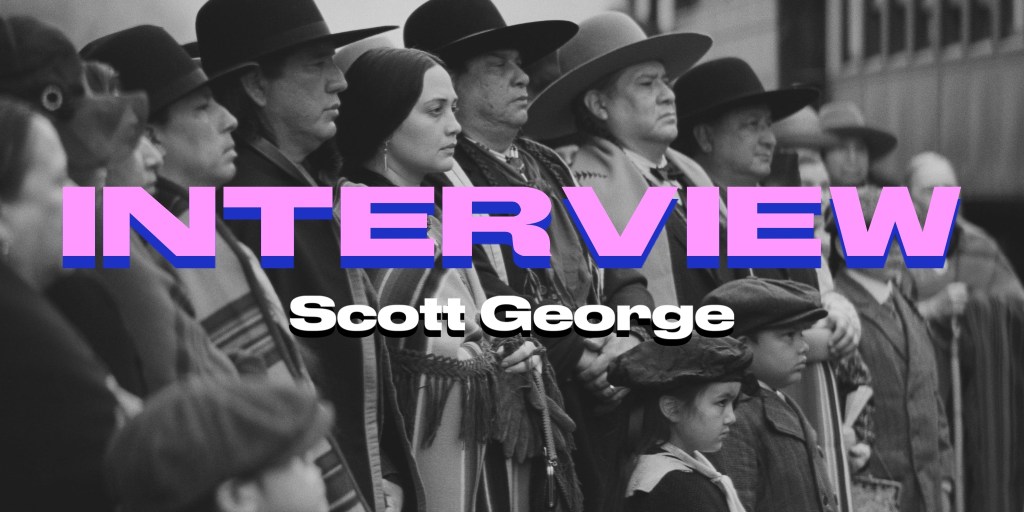
Throughout Martín Scorsese’s Killers of the Flower Moon, greed and power remain prevalent throughout the Osage nation murders. In the stages of the film being produced and filmed, Scorsese created his 26th film with the consultation of members of the Osage community in order to tell the story of the murders throughout 1920s Oklahoma. Offscreen Central had the opportunity to sit down with Scott George about his Oscar-nominated song, Wahzhazhe (A Song for My People), vocables throughout the song, and what he hopes the future generation takes from Killers of the Flower Moon.
Leia Mendoza: Hello! I’m very excited to talk to you this morning about your work. I was reading when you had originally first heard of the project, you were apprehensive and worried about the reason why Killers of the Flower Moon was being made. What was the defining moment that made you realize you had to become a part of this film?
Scott George: Well, I would say that when we were singing and doing our traditional dances, Martin, Leo and Lily and others came to watch our dances. We have little breaks that we take in between singing and dancing, and we were having a water break. So, we were sitting there under the arena and looked down at the crowd and somebody spotted them up in the crowds. At that point, I said to my close friends, “Uh oh, they’re watching us. It’s coming, they’re coming to watch us and they’re going to want to see something like this,” and we were still a bit apprehensive about showing this. Our dances are sacred to us and we don’t allow them to be filmed. When we got the call, it was like “We understand your situation and how you feel, but how would you feel if we did this in a totally different place and just having it in a Powwow-type style.” We thought about it, and we said we could do that, and we understand what you want, and we’ll try to give it to you. But, we can’t give you this.
Leia Mendoza: I’ve watched the film a couple of times and when I watched it for the first time, I have something called synesthesia where whenever I hear music, I see color and textures and whenever I heard the song, it all appears so vibrant and full of life. The words and the rhythm throughout feel lively at the end. Martin had explained that he wanted to portray this at the ending of the film, and I was curious about how you, Martin and Robbie came together in the recording process and how your conversations sounded about the production.
Scott George: In the first part of it, when we composed the music, they kind of left it up to us. They didn’t really tell us too much, except they wanted something with a lot of energy. We kind of gathered what they were wanting from when they were watching us, and we knew that it needed a beat, that the song had that kind of energy in it. So when we started creating it, that’s the direction we were heading. So our collaboration with them didn’t really start on set, and Martin went out and introduced himself. People had told us what he wanted to do, and how it was going to transpire. When we started singing, there was no “That’s not what I want,” he just let us sing. He started moving the dancers around us, and then a couple of times we’d have a cut, and then go back to do something. I think we probably did it 12 or 13 times that day where we sang it all the way through. In that period of time, the only issue we really had was lighting. The sun was going down and it created shadows on our ground. That was the main focus when they were putting the cameras up. Collaboration wise and song wise, we gave Martin and Robbie songs to choose from that we composed. We didn’t hear back from them and then later, they said “We want to do this one,” which is the one I composed.
Leia Mendoza: I was just about to ask about that. I had heard that there were different versions of the actual song towards the end of the song that you and your brother had composed and collaborated on before yours got selected. How different was your brother’s song to the song that you composed? Was it very different or were they similar?
Scott George: There were some differences in it. The message he had was kind of the same, but the words he had used were different. Our songs have two parts to it, they have a beginning, there’s three strong beats in the middle, and then the last part has where the words will end up being. The rest of it is all vocals and music, so that’s where we put the words. The words were different but the message was about the same. I felt like the energy was kind of the same, I don’t know if it was because I called out my people directly as Wahzhazhes, my brothers song didn’t do that. We didn’t really elaborate on it, we just had work to do, so we just got on it!
Leia Mendoza: Vocables are the driving force when you hear the song at the end of the film. I’ve never really seen that before, but I would love to hear more about the vocables and the process behind constructing the song.
Scott George: A majority of plains music is made up of vocables. It’s really nothing more than you just humming a song, and you have that tune in your head where you’re not using any words. It’s kind of like that. The syllables that you’re using to put in that song are universal for all of us. It goes along with it, and unfortunately it’s portrayed in old movies and cartoons as “hey-yahs” and things like that. There’s way more to it than that. If you listen to our music, you’ll have a start, and what would you call that in the music industry, a hook?
Leia Mendoza: Yeah!
Scott George: To us, that start is the hook. And that’s the opportunity for the lead singer to showcase their voice and kind of have everyone come in after that. Once it hits that crescendo or that high part of that, it drops down a little bit. When you start putting those vocables together, I have 40 years of vocal experience in my mind and none of our music is written down. It’s all passed from one to another, and luckily now, we have recording devices to help us with our short term memory! For the most part, when you hear something, you know it or you’ve heard it before, and when you’re trying to make a song, you have to rely on that. You have to rely on other people to listen to this and see if it’s something you’ve heard before. I have friends that I sing with and I’ll call them up, saying “Hey, have you heard this before?” and they’ll say “No, I don’t think so, why?” and I’ll just be like “Nevermind!” and go on my way. So we do that, and sometimes we say “That one part sounds like this song,” and you’re like “Oh, you’re right, it must have been something I’ve remembered from a long time ago.” And you don’t ever know! You could be pulling something up that you heard 30 years ago and never heard it again. You have to kind of play with it and massage it a little bit to make sure that it’s original.
Leia Mendoza: I didn’t know that you had 40 years of vocal experience, that’s amazing. I’m currently in my early 20s and I had never heard of the Osage murders or most of the people who are my age in college with me watched the film and we had conversations about how we had never been taught this period of time in history, or we went through so long without not realizing that this was a historical event that will forever be engrained in history. With creating Wahzhazhe and working on Killers of The Flower Moon, what do you hope is the future message for the next generation, like people my age specifically with not only your work, but the film as a whole?
Scott George: Well, of course, that was a time of a lot of tumultuous people moving around the United States. When you look at those people who were depicted in this film, a lot of the greed that was involved was really prevalent at that time. Especially in Oklahoma, but we weren’t the only ones affected by that. All Native Americans, if you have anything whatsoever, whether it was land, somebody was plotting to take it away from you. It was a really rough time then, and then living with that over the next generations was difficult for our people, and for all Native Americans. What I hope for people to see is that yes, it was a bad time, but you can, as Indian people, come out of that. You can make something of yourself and you can do the things that you want to do. You can still be Native American and still do these other things. We have doctors, lawyers, professional people, but we are all tied to our culture. We all come back to Osage county in June and partake in this cultural history that we have. The other thing that I hope that people take out of this is that it’s time to treat people better. It’s time to treat one another better. Our own people have always told us that no matter what we’re doing, to love one another. Take care of one another. Not just now, but all the time. We try to instill that in our young people also.
Leia Mendoza: Thank you so much for taking the time to speak with me! I hope that we get to see more of you and your work in the future, and where your career goes from here.
Scott George: That would be cool. Thank you so much!
Killers of the Flower Moon is currently streaming on Apple TV+ and back in select theaters.
You can read our review of the film here.
 offscreencentral.com
Leave a comment