
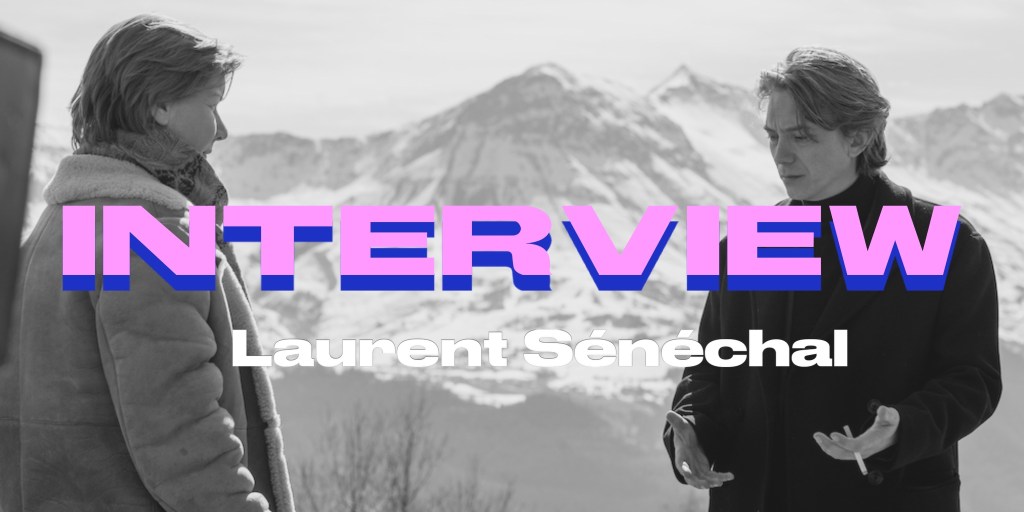
Justine Triet’s Anatomy of a Fall is an exploration of the line between fact and fiction through marriage. Using the minimalism of a courtroom mixed with shaped editing, Triet sets the stage for one woman to defend her entire life from one bad moment. It is not about whether she is guilty or not, but the truth behind a life. Offscreen Central had the opportunity to talk to Oscar-nominated editor Laurent Sénéchal about the relationship between Sandra and Samuel, depicting fake memories, and balancing ambiguity.
Jillian Chilingerian: Congratulations on the Best Editing nomination, this film is truly a gem and I love it when the editing branch decides to do something fun with their nominations and I feel like Anatomy of a Fall best represents that daring pick!
Laurent Sénéchal: Thank you so much! I’ve already won so much with this nomination. I’ll be very delighted to participate no matter what happens.
Jillian Chilingerian: The film is an investigative piece, as more and more unravels about Sandra and Samuel’s relationship, how do you as the editor shape their relationship as it continues to morph with each new detail through the edit?
Laurent Sénéchal: Between the opening scene and the central scene of the quarrel, which is the heart of the film, the script sets out the main stages of these revelations. But in the editing process, we redrew the contours of this path for the viewer, with two main objectives in mind: to maintain the right amount of ambiguity around Sandra’s character and to make Samuel exist as much as possible before the argument, even if we drew a character who exists more through mystery than through unveiling. To give a few examples of editing leverage for the latter point: the credits sequence with photos of the family before the tragedy is an editing idea we came up with very late in the process (the credits were supposed to be on a long shot of the lawyer’s car arriving at the cottage); the choice to keep the long shot scrutinizing Samuel during the autopsy in its entirety; the scattering of photos of him in several sequences of the film; a video of Samuel in close-up without sound that Sandra watches alone one evening (originally it was a literature class Samuel was giving, and was intended to exist in its own right as a flashback, but this sequence didn’t fit in, and even we discovered that by putting it in a computer (which we also took in another sequence where the lawyer was working) all orality seemed to us, in the end, a little pompous, too significant and less captivating than this brief moment of silent cinema; etc.
Jillian Chilingerian: The way Justine Triet frames the story is not to answer whether Sandra killed her husband or not, but how one moment can define a life and measure at what point the relationship died, how did approaching it from this angle versus a direct answer impact your approach?
Laurent Sénéchal: The last thing we wanted was a slightly cynical editing style that took the viewer by surprise, like “we know the answer and we’re going to take you, the audience” from one side of your conviction about Sandra to the other, like an efficient but soulless attraction. We aimed to do everything we could to help the viewer plunge into real complexity, vertigo, and empathy with Sandra, without ever letting go of his or her doubts and reservations. In concrete terms, we selected the most disarming takes in terms of acting, those where Sandra overwhelmed us and exuded the most sincerity (Hüller is generally exceptional from the very first take), moderating her attractiveness by creating doubt through the narrative and the other characters.
Jillian Chilingerian: The fight between Sandra and Samuel is one of the best onscreen arguments in cinema, it is a moment where the narrative takes its change and hits the viewer, how was it to put together that sequence with these two incredible actors and a fantastic script?
Laurent Sénéchal: We wanted to assume the scale of the scene and its repetitive aspect (I don’t know how many times the word “time” is pronounced, but it would be interesting to count). Sandra Hüller was so inspired and dense in all the rushes that, as far as she was concerned, we had to be especially careful not to use only strength, but rather to rely on her power and vary her facets (sincerity, gentleness, manipulation, surprise, bad faith, anger). For Samuel, it took us a while to realize that he was more interesting in a slightly more fragile register than an offensive one, which tended to make him snarling and less captivating. After that, it was a question of craftsmanship, of fine-tuning the chemistry between them. It was very exciting to build. Justine thought that in this kind of scene, there should be ups and downs, accelerations and breaks like in a Cassavetes film, but in the end, the scene unfolds rather linearly, even if at the end there is a real exponential when Sandra blasts Samuel (« your generosity conceal something dirtier and meaner, etc » before we return to the courtroom.
Jillian Chilingerian: This film plays with the idea of false memories especially in those courtroom moments with Daniel where he has to recreate what he remembers, how did you construct and illustrate the complexities of Daniel about his parents?
Laurent Sénéchal: Before this scene, which is the real climax of the character (and of the film as a whole), we had to do everything we could to ensure that Daniel was very present in the viewer’s mind, which wasn’t easy because he had very few scenes in the first two hours (it’s only at the end that we realize that he’s the main character in this story). Apart from all the visions he had during the trial, it was the piano scenes that were our main levers. We totally reconstructed all these scenes, all his progression, and moved scenes like the one that starts the second part of the film (the trial) with him at the piano having progressed, a year later (this scene was originally planned for the verdict broadcast on television). By setting up this piano scene as the cornerstone of this part of the film, the idea is planted in the viewer’s subconscious that everything that follows will concern this boy and that he’s not just an observer (he’s fighting, he’s learning, he’s plotting something). In the end, before his second testimony made up of his partly invented memories when he takes up with just one hand the Chopin piece he used to play with his mother, which continues with the image of him in the attic where his father was just before he fell, we feel that the film is delving into his history, his relationship with both of his parents and all of this happens only through suggestion, without any dialogue, it’s pure cinema. Personally, it’s my favorite moment in the whole film.
Jillian Chilingerian: I have noticed the major differences between an American’s approach to a courtroom drama versus the French, specifically in how the questioning is used to dig into the psyche of who is at the stand versus trying to decipher a final verdict, how did you and Justine collaborate in reinventing how we digest a courtroom drama?
Laurent Sénéchal: This intention (the word is perhaps a little strong) was clear in the script and the cut, but we pursued and refined it in the editing process, if only by choosing not to use score music, for example. Our motivation was not so much to position ourselves against a model as to seek to identify the film’s intrinsic singularity and, in so doing, to essentialize its power by making it as coherent as possible. But it’s hard to be more precise, as it involves a multitude of choices, details that have been constantly called into question, reinventions, discoveries, and so on. It’s a long process of craftsmanship.
Jillian Chilingerian: This could be described as an ambiguous film, but how do you balance it from being too ambiguous where all meaning is lost once you reach the end?
Laurent Sénéchal: Usually, the final emotion in a film arises from a liberation, from the unveiling of an obvious fact that until then had seemed incomplete and muddled. What’s great about Anatomy, and what wasn’t a given, is that it manages to move the viewer (who senses that the child is accomplishing something of the order of his destiny by the end of the film) even as the complexity grows thicker and thicker, since he becomes more and more opaque, joining his mother and the adult world in general. I’m not sure how we managed to introduce the viewer in such good conditions to this room where mother and child are reconnecting in such a complex yet obvious way, if not through hard work with Justine and sometimes Arthur Harari who came to lend us his time, his eyes and his ideas. But to be honest, if what happens between Anatomy of a Fall and the audience is truly fantastic, it’s a bit out of our hands. There’s also a great deal of luck, magic, and the alignment of the planets in this success.
Anatomy of a Fall is currently playing in select theaters and available on demand.
You can read our review of the film here.
 offscreencentral.com
Leave a comment