
The first time I ever fell in love with a ‘performance’ was when I watched Harold Perrineau in Baz Luhrmann’s adaptation of Romeo and Juliet, strutting around in drag, mercurial and glowing as Mercutio, monologuing about sex and death and desire. I was fourteen sat in an English Literature class, utterly mesmerized by this person pretending to be something he wasn’t and completely unable to understand why it felt so viscerally real anyway.
The second time I fell in love with a ‘performance’ was when I was sat in a cinema with a boy I liked, bewildered, whole body taunt with tension as I watched a horrified, frozen Daniel Kaluuya cry a single tear trapped in the darkness of his own mind in Get Out. I’d spent days fantasizing about what it’d be like to go out with this boy, days preparing the perfect outfit to wear; needless to say, I ended up ignoring him the entirety of the film. There were more pressing matters to contend with, like how this actor from Skins was doing what he was doing with his eyes, and why it felt like I’d been shot when the police car pulled up on Chris in the last few minutes of the film. I- like much of the world- was put on notice after that. Kaluuya would be a ‘hidden’ talent no more.
Daniel Kaluuya is the supposed counter opposite of an expected Hollywood success; Black British, born to migrant parents, working class, and it seems, an inherent overachiever his whole life. A writer and actor on the hit British coming- of- age show Skins, he steadily built-up years of experience first on TV (we all remember his episode of Black Mirror) and then turning to film taking on supporting roles in films like Johnny English Reborn (a film so unserious it’s genuinely delightful in its own haphazard kind of way) and Denis Villeneuve’s Sicario as FBI agent Reggie Wayne.
The importance of Sicario to understanding Kaluuya’s filmography cannot be overstated. Not because he is great in it (though he is), but because it presents the perfect little snapshot if what his career could have been like had Get Outnot come around when it had for Kaluuya.
He is severely underused in the film, to the point where you start to wonder what other purpose his character serves other than to inject some melanin into an otherwise all white cast. His motivations to follow the rules and trust the system -though clear- are two dimensional, his character rarely delved into beyond vocalizing dissent for the purpose of creating friction to push Villeneuve’s plot forward. The only real moment of substance he is afforded in the script is easily one of the most poignant moments in the entire film, a simple bar scene in which Wayne ribs Kate about her fashion sense and cleanliness. It’s a human moment, breathed to life by an affable, charming Kaluuya in a flawless American accent. It’s almost cruel, that moment, like dangling food in front of a starving person and snatching it back when they start to reach for it.
Look at how great he is. Now, look as I refuse to utilize that greatness.
Sicario is important because it is proof that even Daniel Kaluuya could have very easily become another tokenized Black actor, having to steal little moments of brilliance for himself like Viola Davis in Doubt.
It is a film that I feel proves everything about what the system is like for Black talent; the big, juicy parts in the critically acclaimed films are rarely for us. The industry is far more interested in keeping us on the sidelines, calling on our talent when it serves them aesthetically. The actor himself talked about wanting to quit around the time Sicario came out and that if it were not for a meeting with a comedian by the name of Jordan Peele, he would have seen no way to go on in an industry run by people who didn’t know what to do with the vast power they’d been given. That moment of disillusionment for the actor seems to have been a turning point in his career, a moment of realignment. The rest of his work reads like a direct rebellion against what is said to possible for a Black actor. He gets the script for Get Out and the rest, it seems, is history.
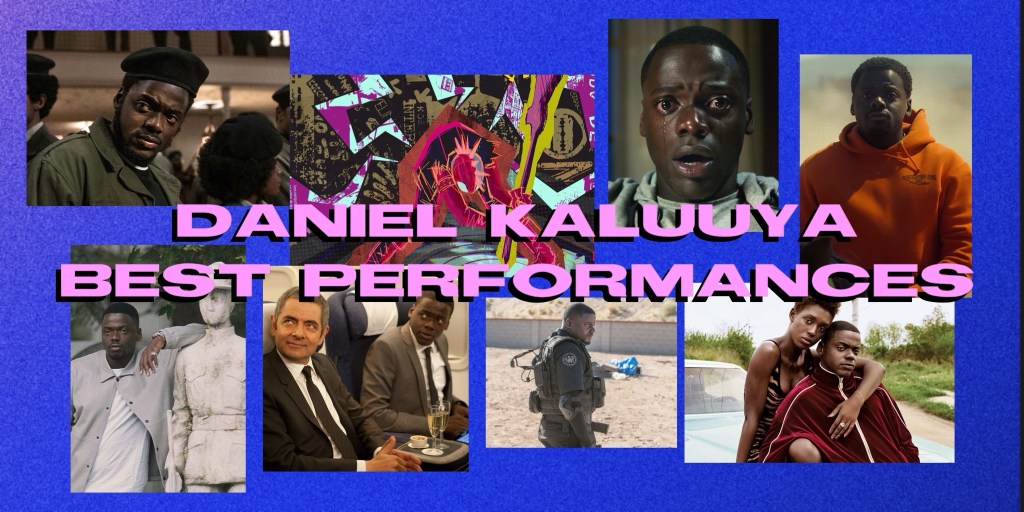
An utterly ridiculous resume follows filled with one critically acclaimed moment of rare perception followed often quickly by another. It has taken me months to complete this ranking, so valid are the reasons for almost all of his films to be at the top that I’ve had to rewatch some of his projects back-to-back in an attempt to narrow them down to just a top five. Try it yourself- bring up his filmography to your cinephile friends and watch as chaos ensues and curses are traded, taste questioned because everyone has a different Kaluuya performance they’ll die defending. I watched 1,200 minutes of Daniel Kaluuya. These are his five best performances.
5. Hobie Brown, Spider-Man: Across the Spider-Verse [Dir. Joaquim Dos Santos, Justin K. Thompson, Kemp Powers]
Hobie Brown took the internet by storm last summer, and it is no wonder. A Black British Spiderman variant, he remains the only character in his post Get Out career that Daniel has played in his native accent. A mix of cockney and South London swagger, Hobie bursts onto screen in a cloud of punchy graphics and heavy metal, guitar in hand, locs moisturized. Kaluuya can take no credit for Spider Punk’s brilliant design, but he can take absolute credit for injecting such life and subtly in to what could have easily been another two-dimensional comic-relief character. On the surface, Hobie presents as a brash, overly preachy figure whose obsession with sounding deep actually makes him sound quite silly. His rejections of everything- and the contradictions that that leads him to-makes him easy to dismiss.
But the longer the film goes on, the more you realize that Hobie is anything but a shallow archetype meant to draw big laughs; he’s radical and revolutionary and so punk in his rightful condemnation of the systems trying to force the same cycle of abuse onto Miles that you can’t help but feel somewhat conned by your first assessment of him. Daniel’ s performance is the perfect blend of big and boisterous as well as quietly determined. A simple authoritative ‘go on’ spurs Miles into finally defending himself, Hobie the not so quiet ally in his corner, the only command uttered in his defense in that room. He’s onscreen for maybe less than half an hour in total and yet, you remember him long after he’s gone. A running theme in Kaluuya’s work is the interrogating of race and how it brushes up against systems of oppression, and this film is just as vital in his filmography at telling us what characters draw him in as Get Out or Nopeis. Voice actors do not get half the credit they deserve in rooting us in these fantastical worlds we would other-wise dismiss, and his performance as Hobie is testament to the actor’s uncanny ability to tap into that natural gravitas of his, even without being onscreen. Hobie- like Kaluuya- has presence, and that’s worth rewarding.
(Also, he gets to be funny in this film. What a rarity. Let this man be funny in films, please.)
4. Slim, In Queen and Slim [Dir. Melina Matsoukas]
Put down the pitchfork and hear me out.
Queen and Slim is that frustrating combination of stunning visually and convoluted content wise, one of those films so pretty all praise for it sounds like some dismissive version of that ‘beautiful gowns’ gif. In a time where we are having credible conversation around why the only stories that seem to get greenlit by studios feature Black trauma, it is warranted and in fact valid to criticize Matsoukas’ directorial debut and deem it another feature fetishizing our struggles.
It is dramatic, twisty and- at its worse- a poorly executed attempt at critique of both our community and the system simultaneously (an impossible feat to pull off side by side). At its best, it is a patient exploration of what it’s like trying to live in a world that refuses you normalcy and love as a Black person. In its supposed pursuit of trying to depict Black people as more than politicized, brutalized bodies in a Trumpian time, Queen and Slim ends up turning us into just that. The film literally ends with the graphic murder of both leads, reduced to bodies once more. I cannot for the life of me erase that love scene intercut with the police shooting from my mind even if I tried to. Nor can I bring myself to defend that horrendous finale.
I will never, though, be able to dismiss the film entirely simply because Daniel’s performance as Slim in that movie encapsulates an old school charisma and essence so rare in films of our era that I think it deserves to be commemorated. He is charming in an endlessly comfortable sort of way, especially at the start of the film. He and Queen (played by Jodie Turner-Smith) go back and forth trading light jabs, supposed opposites. It’s a delight to watch them spar and try to suss one another out.
The film works best when it steps fully into its romantic elements; a slow dance under neon lights between two people who should have more on their minds than their connection but who- for a moment- choose to indulge themselves. A heart to heart in bed after Slim’s gotten his hair shaved, no longer able to hide. A quiet moment of clarity as they realize that they really are all the other person has as all hell breaks loose.
Jodie Turner-Smith does well to hold her own in her film feature debut, but Daniel just has it. And it’s a version of him as an actor we don’t really get to see. He is a romantic lead, a tragic victim, a man made naive by endless faith and a loving family, an affable flirt, all in the span of one film- and he does it all with such realism. We rarely get to see Black actors tap into such softness onscreen, or to witness them fall in love the way Queen and Slim do. What a privilege to see even just a glimmer of what Kaluuya can do as a romantic lead, to witness the old-fashioned weightiness he gives to Slim; what a shame that he had to contend with a script that sacrificed its message for the sake of shock value and undermined his attempts at every turn.
3. Chris, Get Out [Dir. Jordan Peele]
What is there to write about Kaluuya in Get Out that hasn’t already been written? It’s a film so seismic in our culture that classes are being taught at universities to dissect it. All of its symbols, all of the performances have been analyzed over and over again. The praise has been endless (understandably). It remains one of the most important films of the millennia, so I’ll keep this brief and say simply that Kaluuya’s performance as Chris reveals a level of maturity and control that’s hard to understand. And his eyes? They’re like a cheat code for Peele in this film, a secret weapon. Tom Cruise has his run. Florence Pugh has her pouty cry. Daniel Kaluuya has his eyes. Kaluuya reportedly got the role after he auditioned for Peele and was asked to read the same scene over and over again, to cry the same perfect tear and got the job on the spot because he never once missed his cue.
The other impossible feat Kaluuya pulls off in Get Out that I don’t think gets enough attention is just convincing he is playing a nice guy. Chris isn’t extraordinary in any real obvious way. He’s an everyman; he must be both palatable and somewhat forgettable, easily forgivable all at once.
Peele has white audience members’ entrenched racism to contend with. Chris has got to be flawless in his behavior- even at our best we are subject to being asked what we did to draw whatever racialized abuse we face. He must be an everyman so likeable he surpasses race barriers, he must be alert and intelligent enough to override a Black audience’s suspicions, he must be amicable and polite and non-violent and non-threatening so his status as victim is so unnegotiable, everybody supports the murder of an all-American white family at the end and accepts it as just.
And Kaluuya does that and more. He hides his discomfort at the racist jokes he’s subjected to by the family with empty smiles, dismisses off hand ‘jokes’ with uncomfortable laughter, watches in silent protest as they continue to unravel and reveal themselves to be as sinister as he suspects them of being. There’s a moment of pause when Chris breaks free from the operation and he’s stood at the door before he goes to fight his way out the nightmare he’s trapped in where a look passes over his face. I’ve settled on naming it one of resolve, of self-respect. He doesn’t cry or rage in that moment. He accepts that he deserves to do whatever it takes to survive.
He decides that he’ll be the last one standing, by any means necessary. One can’t help but feel like Kaluuya knows a thing or two about betting on yourself even when it’s inconvenient to the powers that be.
2. Fred Hampton, Judas and The Black Messiah [Dir. Shaka King]
There is an understandable cynicism that makes itself known whenever an actor takes on a biopic (phrases like ‘Oscar bait’ are often tossed about online) but this remains of the most natural fits we’ve seen in recent years between an actor and a biographical part.
It’s would be an impossible statement to make about any other actor, considering that at this point Kaluuya had already done Get Out, but it really has felt like his career had been building to a boiling point, that he was collecting things, little moments of creative clarity to disperse everything he’d learned and channel it all into one moment; to me Judas is very clearly that moment.
If you haven’t seen the film watch it. If you have seen the film, go rewatch that ‘I am a revolutionary’ speech he gives. Kaluuya said that he felt the spirit of something descend over him in that room as he was at the pulpit preaching and that remains the only logical explanation for the sheer power and determination present in that moment. Those of us who got to see the film on the big screen have the privilege of seeing everyone in their theater lean forward instinctively as he spoke, a sort of breathlessness taking ahold of everyone. It is a ‘big’ moment, and Daniel’s never-ending capacity for subtlety has meant that he’s never been reliant on volume to make his point- or to make his performance. He’s convincing enough in the silence but my God does his turn as Chairman Hampton make one wish he’d be allowed to let rip some more. It’s intoxicating, the way he dances between resolute and fevered in his speech. It was, put simply, an Oscar winning moment.
He’s a little more extroverted in this film than he is in ‘Nope’ for instance, and it’s a wonderful contrast to have back-to-back. Fred was a young man when was he was murdered by the US Government, eloquent and forever passionate. Kaluuya’s portrayal of him manages to convey his strength of character without turning him into a deity or a God. The purpose is almost not to glorify the man, but his mission and to communicate what these ideas he was willing to die for were.
1. Jatemme Manning, Widows [Dir. Steve McQueen]
Widows is my villain origin story when it comes to awards season cynicism. Critics and their refusal to get things right when it comes to the work of Black filmmakers or to give credit where it is due (and where it is not white focused) seems like a battle we’ll be fighting for a while. Beyond its brilliant script and stellar cast, Widows is so particular and original in its approach to what could have been a run of the mill crime thriller, it’s astonishing it’s somehow flown under the radar.
One of the best parts of the film- in fact one of the best antagonistic characters we’ve seen in film recently- is Jatemme Manning.
If Daniel’s quiet composure in other films is a comfort, in this film McQueen weaponizes it, shapes it until it manifests in an ugly, outrageously watchable villainy. The wildest part is he doesn’t even seem to really be doing a lot when he’s onscreen. He stands silently in the corner most of the time, simply observing with a bored look on his face as his brother the wannabe politician grandstands and schemes. And when he does move? Well, you find yourself wishing that he would go back to his passive silence.
There’s a moment where Manning pulls up asking about his brother’s stolen money to this indoor gym. Realizing the men he’s been looking for are also amateur rappers, he demands they entertain him. The second they start, he’s up in their face, head bobbing in time to the freestyle, seemingly lost in the music and then on a dime, everything changes. The man is dead. You don’t even see the gun; you don’t even get a moment to process the first murder before it’s very swiftly followed by another. You can’t place the moment Manning goes from open and seemingly earnest to suddenly cold, focused, devoid of any human emotion, the change happening so quickly you start to question if your mind conjured the whole thing exchange up.
It’s like seeing a cat play with a mouse it’s about to eat. It’s sick, but it is so delicious to watch you actually mourn his loss a little when he’s dead. Manning is the anti-thesis of everything we have seen Kaluuya be onscreen. You hate him, fear him. He is the hand of subjugation and calamity his other characters are often trying to escape. He gets to be despicable in Widows and when we talk about range, this is what we are talking about. Diversity in storytelling is not restricting us to playing solely victims or likeable onscreen; true equity is to let us explore all sorts of characters, with all kinds of motivations. Manning never stops surprising you when he’s on your screen because even if he’s going to play a criminal henchman, Kaluuya’s going to give you layers.
He is utterly unforgettable in Widows. Kaluuya is unforgettable, it seems, in most things.
In an era where we are watching Hollywood actively fight against the progress that would give audiences the art they deserve, where Black and brown actors and writers and directors are fed empty promises of progress, it is a miracle that a talent like Kaluuya has risen.
The film star is dead, critics often lament. Where is our generation’s Denzel or Streep? Where are the actors whose filmography speaks to something greater than some back to back good jobs, that surmise entire moments in film history?
Well, the answer’s very clear.
His name’s Daniel Kaluuya. And the most impressive thing about him is that he seems to just be getting started.

Ayan Artan
Essayist/Screenwriter
@artan_ayan She/Her
Black Brit. Rom Com truther.
Fave Actor: Daniel Kaluuya
Zodiac: Leo
 offscreencentral.com
Leave a comment