
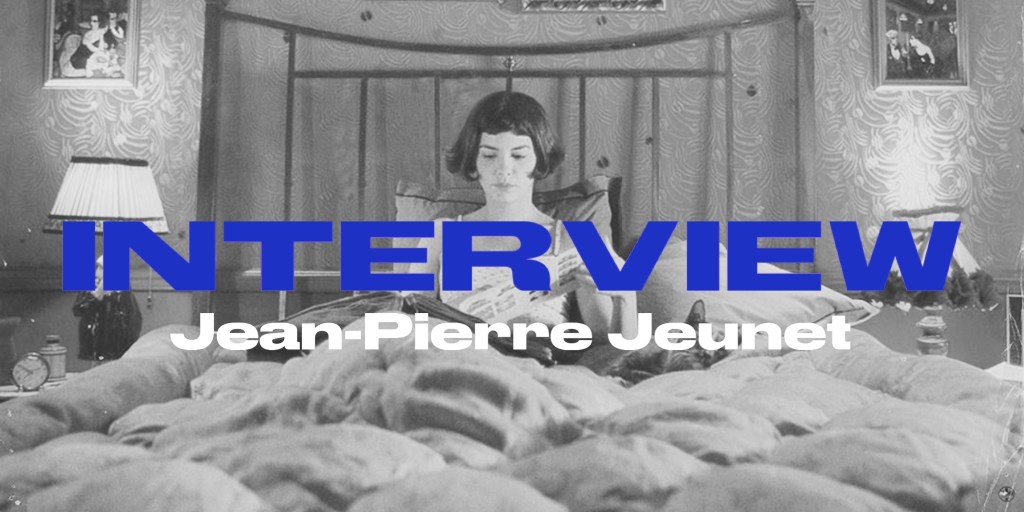
It has been a long day of interviews for renowned filmmaker Jean-Pierre Jeunet. “Speak to me very slowly and distinctly, because my English is very bad,” he tells me in perfect English. Jeunet is making the rounds as his 2001 film, Amélie, prepares for re-release on Valentine’s Day. Amélie follows the titular character as she begins to take on random acts of kindness in order to touch the lives of those around her. Unbecoming, Amélie works at a cafe, observing those around her. But slowly, she begins to yearn for those to notice her.
I first saw Amélie in high school. I was taking French as my foreign language course, and my teacher just happened to mention a film that was released a few years prior. And at fourteen, seeing Amélie completely revolutionized cinema for me as an moviegoer. It showed the depths, the creativity, the artistry which collides in filmmaking. It has been revolutionary for many and to this day, Jeunet has a hard time comprehending its monumental influence.
“Two years ago, it was in Cannes Film Festival, they made the screening on the beach for free, you know, and they expected me probably they told me 50 people because it was a rainy day. No, it was packed,” Jeunet says. “So 23 years afterwards. It’s crazy.”
Even two decades on, there are numerous moments where he witnesses the impact of his film. “Once, I was with Jodie Foster at the Café des Deux Moulin, the cafe in Amélie, for an appointment [to talk about] The Long Engagement, she has a small part in my next film. And we were outdoor waiting for a taxi. And some young people rush to take a picture of the cafe, like, every four minutes. we were between the people and the cafe, Jodie Foster and I, and we did not know if they recognized us or not. And, I swear, a girl said, ‘Can you please move?’” Jeunet recounts with a laugh.
Despite his anonymity, he holds Montmartre dear. It is his neighborhood after all. It features as a character in his film. When his wife, whom he met on the film Alien: Resurrection, is American. “When she saw the film dailies,” Jeunet tells me, “she saw the roofs of Paris and she told me it will be a success in the U.S.A. And I said ‘why?’ [She told me,] ‘Because the roofs.’ I said, ‘The roofs? But Americans don’t give a shit about the roofs of Paris.’ ‘No no,’ she said, ‘ you’re wrong.’ She was right.” The film wasn’t just a success in the U.S. Amélie found international recognition. The film was nominated for nine BAFTAs – Jeunet was nominated for Best Director – and received five Academy Award nominations, with Jeunet and Guillame Laurant nominated for Best Original Screenplay.
The film also demonstrates the layers of artistry in filmmaking. For, it is not just Jeunet’s vision and screenplay but his collaboration with other artists which brought this film to life. From the cinematography to the costume design, the production to the hair and makeup, all of these departments worked together to create the perfect visual experience. And crafting the world in which Amélie exists was crucial for Jeunet. “There is a trick, you know, you love to speak with pictures frames,” he tells me. “Because when you speak with words, everybody can imagine something different. And the format, I remember I was in a birthday party, and there was a painter from Montmartre, but I didn’t know. And he had a book of paintings, and it was totally green and red and warm. And it was exactly what I wanted. And I chose two or three pictures and I gave the pictures to every department. And we put that on the walls to see that every day as references. And at the end, it was a way to push the people the same way.”
All these years later, Jeunet is not only grateful for the people who have been effected by his film, but he hopes younger generations will come and connect with Amélie. I ask Jeunet what he’s looking forward to with the re-release of Amélie. “I hope they will have the same pleasure because, you know, this film is so timeless and is not all exactly the same thing,” he says, “The reaction are the same everywhere because I traveled a lot with the film, and the reactions are same everywhere.” But it is not just people revisiting a film that Jeunet hopes will connect with the film. “I hope some young generation, some young people, they will discover something,” he says. “Sometimes, some young people ask me to sign a DVD and they say ‘this is a favorite film of my mother.’ I would like to say, ‘watch it.’”
Before we part, he asks me where I’m located. I tell him I’m on the East Coast. “I’m talking to so many people from all over,” he remarks. That’s just proof of the rippling effect Jeunet’s film has had on others. It is astonishing the power film had in 2001, and all of these years later, to see the same global appreciation and adoration of a film like Amélie is continued proof of the magic of cinema.
Amélie is back in theaters now.
 offscreencentral.com
Leave a comment