
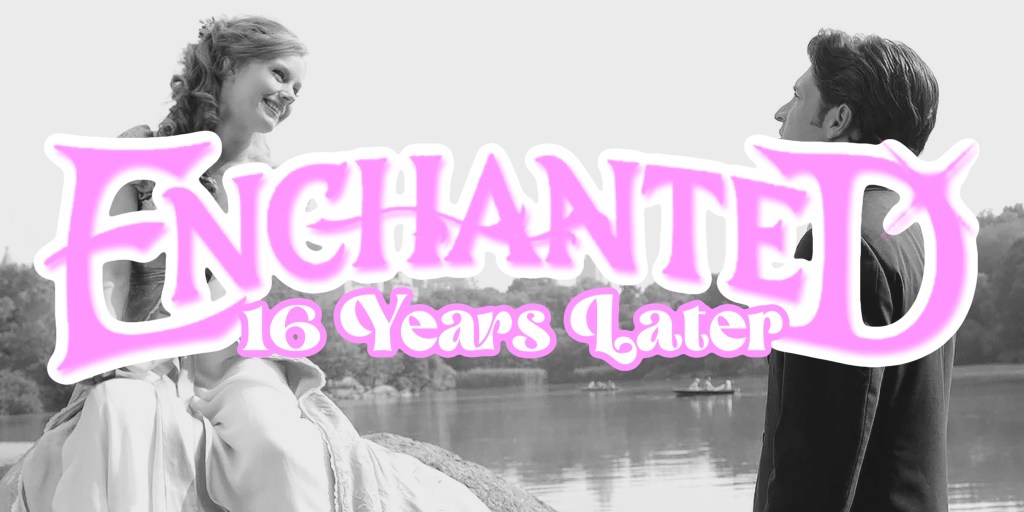
“The real world and the animated world collide.”
There is more to the tagline of Disney’s magical Enchanted than meets the eye. Directed by Kevin Lima and written by Bill Kelly, the film blends delicate hand-drawn 2D animation with live-action effects to bridge the bustling streets of New York City (where there are “no happily ever after’s”) with the dreamy meadows of a fantasy land called Andalasia. The film’s visual balancing act mirrors how joy and optimism are infused into a more cynical, grounded perspective on the four-letter word that unites us all: love. The “lovey dovey” version of romance sprinkled across Andalasia sees an awakening in the real world, where relationships are complex, and anger is an acceptable emotion. Enchanted marries fairytale and reality to find a happy medium between the two; not only in terms of the visuals, but within the characters who inhabit this world of colliding definitions on romance. At the heart of the film’s storybook premise is a fairytale princess learning how to be more human. Celebrating its 16th anniversary this year, the film’s magic trick is no secret. As princess Giselle, the brilliant Amy Adams has a tremendous role to play in the overall endurance of Enchanted since its 2007 November release. With doe-eyed effervescence and remarkable commitment, from her melodious voice work to every little expressive mannerism, Adams’s performance is the film’s happily ever after. She plays the character’s animated traits with an open heartedness that grounds her into the real world.
Narrated by none other than queen Julie Andrews, the film introduces princess Giselle with a charming sing-along song fit for a quintessential fairytale. Surrounded by woodland animals atop the forests of Andalasia, Giselle dreams of a true love’s kiss, and a prince to come with this. She fashions a wooden prince adorned with books and greenery, unwittingly creating the outfit her real true love would wear in the story’s final act. The film begins with the early assumption that Giselle has already found her love. She meets prince Edward (a delightfully goofy James Marsden) and the two are set to wed, but their plans are thwarted by Edward’s evil stepmother, Queen Narissa (Susan Sarandon). Threatened by the idea of being dethroned, the evil queen banishes Giselle to modern-day New York City, where the princess becomes a live-action version of herself in a setting not quite as whimsical as Andalasia. As a bewildered Giselle tries to find her way home, she meets and falls in love with Robert (Patrick Dempsey), a divorce lawyer whose heart is on the mend. Robert and his daughter Morgan (Rachel Covey), who find Giselle in a glittery wedding dress on a sparkly castle billboard one rainy evening, welcome her into their home. Romantic tension builds between Giselle and Robert, as the characters’ contrasting views on love awaken new emotions and experiences of longing for both of them.
Enchanted works as a charming twist on the fairytales that are wrapped in neat emotional bows. Dancing on a tightrope between sincere and satirical, the film centers on the emotional journey of Giselle’s character. She embodies the power of love and infectious joyful energy, while also learning how to see a grounded version of romance without rose-colored glasses. The film explores Giselle’s gradual learning of a realistic fairytale while also retaining a sense of optimism around dreams coming true, whether it be through the chipper performances or upbeat musical numbers. The songs of Enchanted are among its greatest strengths. The film successfully incorporates elements of the musical genre with fun choreography and catchy lyrics that balance being tongue-in-cheek with being sincere, from “True Love’s Kiss” and “Happy Working Song” to “That’s How You Know” and “So Close.” As well, the characters’ attitude to music in the film is further indication of a subtle satirical lens. For instance, Giselle excitedly suggests Robert should sing his girlfriend Nancy (Idina Menzel) a beautiful ballad, so that Nancy will know for sure that he loves her. In another amusing moment, when prince Edward breaks into “True Love’s Kiss” upon finding Giselle in New York and noticing that she is not singing with him, she replies with, “I was thinking.”
The crafting and use of music in the film was a major highlight at the 80th Academy Awards as well. Enchanted received three Oscar nominations, all in the Best Original Song category (“True Love’s Kiss” missed out). While none of the songs won the Oscar (the honor went to “Falling Slowly” from John Carney’s musical drama Once), the music of Enchanted remains memorable to this day. Composed by Alan Menken and written by Stephen Schwartz, the original songs and score convey princess Giselle’s optimism so strongly, you could practically envision sparkly animated musical notes floating around her. The chronological order of the songs as they appear in the film also become progressively less Disney-coated and more contemporary, mirroring Giselle’s journey into a maturing human character in the real world, all without losing their dreamy essence.
The music of Enchanted was so well received, it also brought upon a live performance of “Happy Working Song” by Amy Adams during the 80th annual ceremony. Considering how the song calls on Giselle and her animal friends to tidy up a messy apartment, imagine the task of translating that energy solo on stage, and without the support of enchanting visual effects. Adams evoked magical storybook vibes with stage presence alone. Her emotive voice and sincerity grounded a chipper song of make-believe into reality. The simplicity of Adams’s Oscar performance speaks to just how well she was able to lose herself in the clouds as a quintessential Disney princess, and incorporate the melodies of a bouncy fairytale song, all through voice and mannerisms alone. However fluffy Enchanted can be, the film retains its sincerity in large part thanks to Adams’s commitment to an emotionally honest portrayal. The enduring conversation around the film tends to center on holding her performance in high regard. From her animated facial expressions to the cheerful tonality in her princess voice, she deftly conveys the sensation of a fantasy character immersed in real life, with the added layer of navigating newfound inner conflict. In one of the most tremendously acted scenes of her career — “You make me so…angry!” — she charts Giselle’s wide-eyed discovery and giggly squeak of excitement at feeling anger for the first time. Adams captures several realizations in one shot, not only that she has the capacity to feel different emotions but also that she has strong feelings for Robert, and her innate hopefulness towards love has an impact on him.
Complimenting Adams’s magical performance, the film’s technical achievements bring out a changing perspective on the fairytale romance. In particular, the costume design by Mona May (whose iconic credits include 1995’s Cluelessand 1997’s Romy and Michele’s High School Reunion), and how the live-action wardrobe pulls inspiration from the animated fabric of Andalasia. Giselle’s flowing dresses, reflecting the meadows and streams of her fantasy land, become more structured and modern in the film’s final act. The ball gown costuming, particularly Robert’s outfit, also makes a neat reference to the woodland prince that the animated version of Giselle fashions at the beginning of the film. Not only was Robert the prince all along, but Giselle always had the capacity to feel something new beyond the world she inhabited. The kingdom of Andalasia was too small a place to house what she was dreaming of.
Looking back on Enchanted today, the concept of Giselle learning how to be human and embracing the complicated mess of living in the real world is on some level reminiscent of a little film that came out this summer, Greta Gerwig’s Barbie. Adams’s portrayal of Giselle evokes a newfound capacity to feel, and her performance to an extent infuses a similar sensation to the emotional journey Margot Robbie charts as stereotypical Barbie in Gerwig’s sublime take on life in plastic. In Enchanted, Giselle sprinkles fantasy and the stuff of dreams into an environment, a home, a father, and daughter, that have gone on too long without such things. It is through Giselle’s presence that Robert, who expresses not wanting Morgan to grow up with a false idea of dreams coming true, learns not to sacrifice the dream world entirely.
While Enchanted has elements that shine independently, from the delicate costume design and entertaining music, to the blend of animation with live-action, Amy Adams’s Giselle is the fairest of them all. Adams’s heartfelt and sincere performance makes the stuff of fairytales feel true to her surroundings, as true as it is to Giselle. Not only does her character strongly convey what works about the story thematically, but her performance single-handedly embodies the film’s premise and gives the viewer a sense of truthfulness to hold onto in a world of make-believe. She is the key to the film’s success, and while its 2022 sequel Disenchanted doesn’t feel as magically resonant, there is something to be said for Adams’s unwavering commitment to her portrayal of Giselle after all these years.
 offscreencentral.com
Leave a comment