
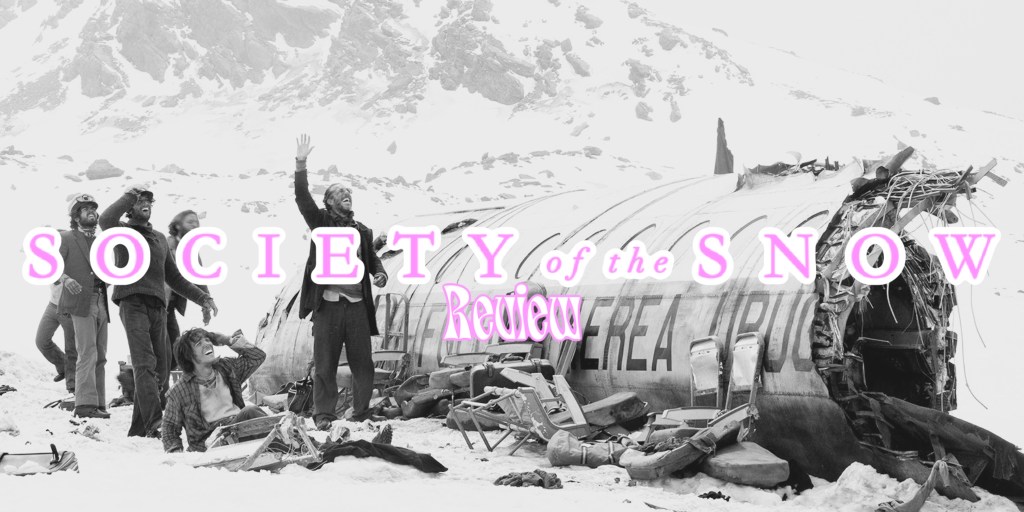
Society of the Snow is a brutal, uncompromising telling of one of the most famous survival stories of all time. J.A. Bayona’s film sets a new standard for survival films of real-life tragedies as it’s told with realism and emotion without sensationalism.
J.A. Bayona has previously explored stories of the human will to survive in the midst of indescribable disasters, most notably in The Impossible. In his latest film, Society of the Snow, Bayona flexes a new muscle in storytelling as he delivers a story many of us know but from a new perspective. Adapted from Pablo Vierci’s book, Society of the Snow takes a different approach as it tells the story of not just the survivors of the harrowing 1972 airplane crash in Argentina but includes the perspective of the 29 victims who survived the impact of the crash but passed due to the elements after. Another unexpected change in the storytelling is that the film’s narrator is not one of the famous survivors, but Numa Turcatti (Enzo Vogrincic), one of the casualties. By allowing audiences to see the sheer will to live of the men and women who survived this horrific plane crash, Bayona delivers a film on how humanity can truly come together in the worst of times.
Society of the Snow follows as the Old Christians Club Rugby Team departs Uruguay to head to Chile for a match. The film holds no punches as you see every loving goodbye at the airport knowing what is to come yet this is not done in a manipulative manner, Bayona allows the typical airport goodbyes unfold just as they most likely happened. The moments on the plane before the crash are daunting as audiences are well aware these are some of the last moments this group will be laughing and smiling so effortlessly in the film. As the turbulence becomes worse, the young men begin to take their seats on the plan and all of the noise cuts out to the loudest kind of silence before the plane strikes the Andes Mountains.
The reconstruction of the crash itself is some of the most visceral filmmaking seen in recent years. The editing, sound, and visual effects truly make the plane crash sequence feel so horrifically real and visceral. Society of the Snow keeps the audience in the middle of the crash as one wing is severed, the plane snaps into two large pieces, and the cockpit is crushed. Not only can you hear bones breaking and metal crunching, but you can also see the impact on each passenger. This is not for the faint of heart. Bayona’s sharp hand never loses momentum in the visceral crash scene as it remains focused in realism throughout a scene you won’t notice you were holding your breath during.
Society of the Snow doesn’t lose momentum after the crash as it instantly becomes a story focused on the determination to stay alive in order to be rescued. Numa narrates as more passengers pass away, they attempt to find food and supplies, and days tick on. While some may have complaints that we get no backstory or character introductions, I think Society of the Snow spends its time teaching us about each character and how they cope after the crash in a way you get to learn about them. No death goes unmarked without mentioning the name and age of the victim. There is nothing that feels exploitive in the filmmaking here. The film may feel unbelievable to some; how did they survive this plane crash to then survive being buried by a snowstorm and an avalanche? These moments are full of tension, and it begins to feel as a viewer just as if you can’t watch another horrifying thing happen to them. Once the storm settles, the real battle begins, just waiting in utter silence.
With the use of a radio, the survivors are alerted to the search party being called off due to the weather. It’s not enough to say they’d be exhausted and frustrated, it feels as if you’re listening to their death sentence. As Society of the Snow goes on, the remaining passengers are shivering, waiting, and depleting as their food supplies vanishes and more casualties accumulate. Eventually, the conversation begins after implied whispers of some chatter on a food supply option. Bayona and his co-writers use the discussion between survivors as a way to truly lay out the terms of their situation. They worry it’s a crime and then worry about their faith, as most of them are Catholic. There was no other option but cannibalism if they wanted to survive. None of the survivors are portrayed as anything but desperate to find a way to live. There’s no graphic imagery associated with the cannibalism in the film, no blood or gore, which is admirable and honorable of the storytellers here for the victims and survivors.
The psychological effects of their situation take a toll on the remaining survivors. They’re isolated still to this snow-covered valley without any hope of being rescued. Numa, who refuses to partake in eating the dead, begins to struggle to the point where he might succumb to the starvation, and he eventually gives in. Most of the survivors begin to provide permission for the others to consume them if they pass on forming a sort of society between them all. Eventually, the preparing of their new food source becomes a routine for them, and this is, unfortunately, where the movie drags a bit. Bayona refocuses as two of the survivors head out to find some sort of civilization. As the two men encounter a man on a horse, Society of the Snow picks up the pace as the news spreads of the victims of the plane crash being found.
As the survivors are reunited with their families, the film never becomes focused on the reunion itself. Bayona focuses on the survivors and their haunted expressions as they heal in a hospital from the long-term effects of starvation, being in the sun, and the cold weather. The look in their eyes is a completely different expression than one you would think you’d see of a group of people being praised as heroes. While the film does have some pacing issues, it’s a tremendous technical achievement. Pedro Luque’s beautiful camerawork not only keeps up with the visceral storytelling but is breathtaking in the way he captures the isolation and snow surrounding the crash site. Michael Giacchino delivers another perfect score that keeps the momentum going throughout the film. Society of the Snow is a brutal, uncompromising telling of one of the most famous survival stories of all time. Bayona’s film sets a new standard for survival films of real-life tragedies as it’s told with realism and emotion without sensationalism.
Grade: B+
Oscars Prospects:
Likely: Best International Feature, Best Make Up & Hair Styling
Should be Considered: Best Original Score, Best Sound, Best Adapted Screenplay, Best Film Editing, Best Cinematography
Release Date: December 15, 2023 (Theaters), January 4, 2024 (Netflix)
Where to Watch: In Theaters

Kenzie Vanunu
she/her @kenzvanunu
Lives in LA with her husband, daughter and dog. Misses Arclight, loves iced vanilla coffees.
Favorite Director: David Cronenberg
Sign: Capricorn




 offscreencentral.com
Leave a comment