
Asteroid City, while full of charm and style, feels stiff and at times held back by the stylized signature of Wes Anderson. Despite fleeting moments of powerful commentary on grief, parenthood, and human connection, the film feels dry and rigid overall. If the film had been more story-focused, this could have potentially been one of Anderson’s best films.
Wes Anderson is known for building eccentric worlds that are identifiable as a Wes Anderson film from first glance by avid cinema-goers to general audiences, a feat that is not easy for any filmmaker. In Asteroid City, the style seems to overshadow the substance in the film. The latest Anderson film feels overstuffed, with actors dropping in for small cameos to its unfocused meta commentary. While Asteroid City has genuine moments of exploring grief and navigating parenthood, the film quickly moves from one scene to another, allowing no time to enjoy the powerful moments sprinkled in a stiff film.
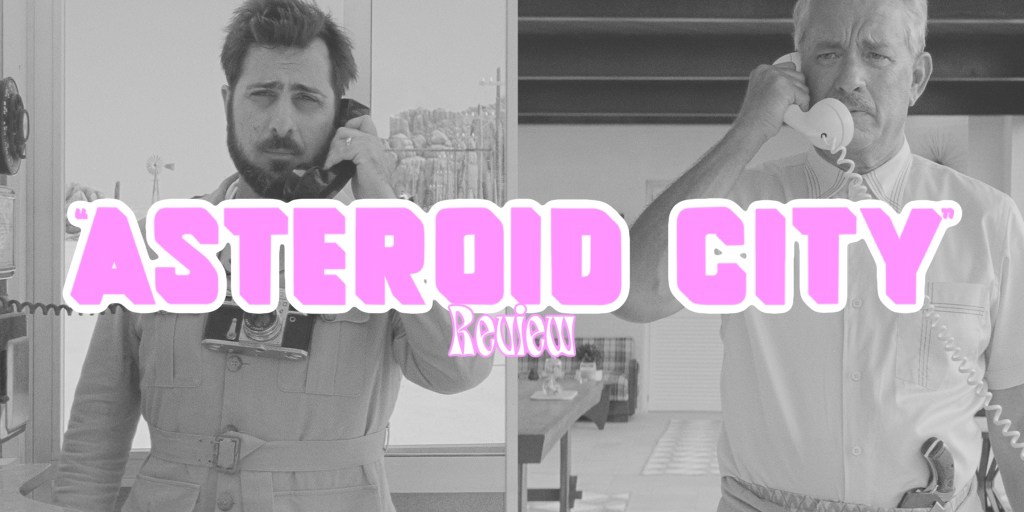
Asteroid City is a show within a film staging a play. Set in 1955, we begin with the television show host (Bryan Cranston, channeling Rod Sterling) announcing their latest segment will showcase the staging of a play called ‘Asteroid City’ by playwright Conrad Earp (Edward Norton). The television show bounces between the origins of the writing of the play, its casting, development, and production in black and white. The scenes in a vivid tint of color are scenes in the desert, performed for an audience we do not see. The play follows Augie Steenbeck (Jason Schwartman), a war photographer who just lost his wife, but hasn’t told his four children, including Woodrow (Jake Ryan) and three young girls. Their car breaks down right as they reach their destination, where Woodrow is to present an invention alongside a handful of other talented teens at an annual stargazing convention in Asteroid City, population 87. Once in the town, Augie calls his father-in-law, Stanley (Tom Hanks), to pick up the girls while the car is being repaired.
In town, Anderson introduces a plethora of characters played by new and familiar Anderson actors: Tilda Swinton, Jeffrey Wright, Matt Dillon, Liev Schreiber, Steve Carell, Maya Hawke, Rupert Friend, and many more. Augie meets famous Hollywood actress Midge Campbell (Scarlet Johansson) and her daughter, Dinah (Grace Edwards). Augie’s son Woodrow immediately catches the eye of Dinah as they are waiting for their convention to present. Their event is interrupted by an alien appearing in the middle of a gathering. In response, the federal government quarantines everyone at the convention until further notice.
The film is jam-packed with actors making small appearances, which is, at times, distracting. Asteroid City, however, is stunning to look at it. The sets, built on location in Spain, include desert landscapes along with a beautiful old-timey gas station, diner, and motel with cabins. The production designer is Anderson regular Adam Stockhausen, which really nails the Anderson look that has been duplicated time and time again. The 50s era works well for Anderson as his color palette in the film complements the time period well. From real estate to martini vending machines, there’s an invention for everyone in Asteroid City.
Schwartzman has never been better despite the material at times holding him back from delivering an Oscar worthy performance. He’s given the opportunity to play so many sides of a character and delivers some of the film’s only truly heartfelt scenes. Wright continues to showcase he’s one of the best actors to work with Anderson; he lights up any scene he’s in and effortlessly blends into a new Anderson world. Hanks feels rigid, out of place; the role eerily feels written for a different actor. Some of the cameos in the film feel overdone (Jeff Goldblum), but some bring a much needed surge of energy to the film (Adrien Brody and Willem Dafoe).
After the first twenty minutes, as the aesthetic plays out of the newest world from Anderson, the novelty wears off. The scenes drag on at times to have no reveal or purpose while other scenes feel rushed without any real chance to deliver the substance. Asteroid City, while full of charm and style, feels stiff and at times held back by the stylized signature of Anderson. The aesthetic drowns out any goodwill from the performances at times. Asteroid City begins to dive in on themes of grief, the worries of parenthood, and the extensional crisis of ‘what are we doing here’ but it keeps these themes – and the audience – at arm’s length. If the film had been more story-focused, this could have potentially been one of Anderson’s best films.
Grade: C
Oscars Prospects:
Likely: Best Production Design
Should be Considered: None
Release Date: June 16, 2023
Where to Watch: In Select Theaters

Kenzie Vanunu
she/her @kenzvanunu
Lives in LA with her husband, daughter and dog. Misses Arclight, loves iced vanilla coffees.
Favorite Director: Darren Aronofsky
Sign: Capricorn




 offscreencentral.com
Leave a comment