

From the first shot, director Tina Satter creates an unsettling retelling of an infamous whistleblower interrogation through minimalistic design, natural performances, and disoriented editing leading to one of the tensest films of the year.
The original story follows a former US Air Force translator, Reality Winner (Sydney Sweeney), who leaked an intelligence report to an online publication in 2017. The report detailed Russia’s attempted interference in the 2016 US presidential election. Winner’s actions resulted in receiving the longest prison sentence ever for the unauthorized release of government documents.
Satter utilizes the original FBI transcripts and audio recordings to keep it faithful to the actual interaction. Every pause, cough, and laugh is kept to add a layer of realism to a story that could have easily been overdramatized. The recordings serve as a reminder that these are the facts of the situation Winner was subject to. Satter builds off of the basics of her play Is This a Room to transform Reality into an impressive directorial debut.
The way whistleblower stories are presented in the media is pretty simple, with the person of interest normally being accused of betraying their country, but the full interrogation adds nuance to Winner’s case. Like many Americans, Winner was angry with the results of the 2016 election, causing her to take action, but she doesn’t fit the mold of what someone would expect a whistleblower during this time in politics to be. She has automatic rifles in her bedroom and repeatedly mentions how she wants to dedicate her life to the armed forces. There are a lot of contradictions to her; she is just a human who, at the time, was impulsive.
Sydney Sweeney gives a performance for the ages by tapping into the insecurity of Winner presented in the transcript. Sweeney doesn’t rely on mimicry to embody the character of Reality, she uses the tools of the audio recording to bring her to life. Over the course of the film, she perfectly captures the whirlwind of emotions this woman goes through. In the beginning, she uses humor to try to alleviate the situation which feels like Sweeney just being herself. Since the film takes place mostly in one fluorescent room, she doesn’t have anywhere to hide which leads to an impressive performance. Sweeney’s portrayal, as well as those of the two FBI agents, feels so refreshing simply because they are talking normally instead of in long interrupted monologues.
Reality is a woman who took on more than she could in an act of confidence. Sweeney’s Reality, opposite the two male FBI agents, shares a glimpse at how gender roles impacted her convictions. Revealed in the story, Winner is a CrossFit devotee and has self-defense on hand as well as being a skilled translator, her intellect and physical being surprising to the patronizing men. They slowly break her down over time into a bumbling mess, willing to comply. This entire interrogation and how it was presented in the media points to how it was more about her gender and politics than the crime she committed.
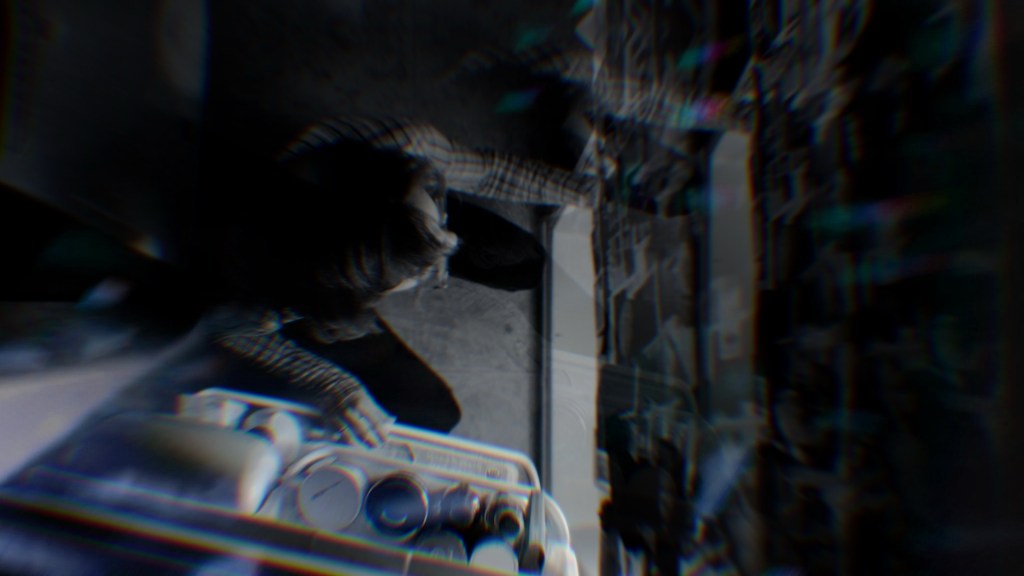
A major distinction between the play and the film is the film’s use of location. Satter starts her story on the street with Reality being pulled over by the FBI with simple questions, as the interrogation progresses the location gets smaller and the questions get more specific replicating a sense of suffocation. An interesting aspect of the film is its use of imagery placement to communicate redacted lines in the transcript reminding the audience that this is still an active investigation. It is a lot supernatural which no one would expect in a film about classified documents, but furthers the eerie feeling introduced early on.
American society is always in flux in terms of the discussion about national security and whistleblowers. We have seen moments when whistleblowers are fully embraced as heroes when their leaks benefit a certain narrative and other times when we see them as a threat who doesn’t deserve human conditions, as seen with the Julian Assange or Edward Snowden cases. The film achieves the goal of condemning how the media handles whistleblowing in the case of Reality, where she was promised anonymity and then was outed by the same outlet simply for fame.
Reality takes the simple media portrayals of these characters and offers a thrilling exploration of the truth that doesn’t hide behind glamour but is simply effective by being what it is.
Grade: A
Oscar Prospects:
Likely: None
Should be Considered: Best Editing, Best Adapted Screenplay
Where to Watch: Max

Jillian Chilingerian
she/her @JillianChili
Lives in LA
Favorite Director: David Fincher
Sign: Leo



 offscreencentral.com
Leave a comment